We’re all familiar with the impact of shrinking school budgets over the past few years. One unfortunate consequence has been the decline in funding for teacher participation in national and international conferences. Avenues for teacher learning have shifted and expanded as technology has given rise to new forms of professional development. When it comes to effectively using new technologies to support student learning in particular, these seeking out professional development opportunities is essential. The IRA Position Statement, New Literacies and 21st Century Technologies (IRA, 2009) calls for professional development that provides opportunities for teachers to explore online tools and resources expected for use with students. The statement asserts that it isn’t enough to just make new technologies available to students but to provide options in ways to use them to access information and share ideas. To inspire new ways of thinking about the use of technology, tangible ideas and examples of what knowledgeable teachers have implemented need to be shared widely and discussed. This post introduces free PD resources and online communities that support teachers in integrating digital technologies into learning activities in meaningful ways.
The IRA Standards for Reading Professionals (2010) encourage teachers to integrate technology into student learning experiences. More specifically, learners are expected to engage in opportunities that utilize traditional print, digital, and online reading and writing and represent various genres and perspectives, as well as media and communication technologies. The integration of technology into literacy learning is also called for in the Common Core State Standards (2010). Students that meet the standards are able to, amongst other aspects, use technology and digital media strategically and capably.
Professional development efforts such as the New Literacies Teacher Leader Institute (http://nli2012.wikispaces.com/Home) offer transformative models that expand beyond the school level and help build extended learning communities that promote lasting change. This week-long institute addresses ways that new digital tools can create challenging and engaging learning opportunities for students and teachers in K-12 and higher education. Participants come together to network, share ideas, boost their leadership skills, and create technology infused curriculum units they can implement in their own classrooms. For teachers who are unable to attend such an institute in person, online resources can be explored and discussed with colleagues to support implementation.
Available resources include videos, instructional suggestions, readings that link theory to practice, and online networking tools which allow teachers to connect with others who have similar goals and interests. Teachers who tap into the wide range of social networking tools that are available to educators can participate in virtual learning experiences that can be customized based on the needs in their own setting.
Rick Beach (from the University of Minnesota) and I will be giving a talk at the K-12 online conference (http://k12onlineconference.org/) coming up Oct. 15 – Nov. 2, 2012. This is a free online conference open to anyone. This all volunteer event is organized by educators for educators with the goal of helping educators make sense of and meet the needs of a continually changing learning landscape. Presenters will share ways to integrate emerging technologies into classroom practice. The schedule of session is available at http://k12onlineconference.org/?page_id=1091. Our session, entitled Using iOS App Affordances to Foster Literacy Learning in the Classroom is available for download at http://ge.tt/6EtYbCP/v/0.
Literacy Beat aims to build a professional learning community amongst its readership. Please make a comment suggesting other professional development outlets or professional learning communities we can learn and benefit from. These shared resources will allow us to expand our online networks and be in touch with new resources and ideas that benefit our teaching and our students learning. We look forward to your comment!
International Reading Association. (2009). New literacies and 21st century technologies: A position statement of the International Reading Association International Reading Association. Newark, DE: International Reading Association.
International Reading Association (2010). Standard for reading professionals—revised 2010. Newark, DE: Author.
Usually I blog about digital tools and instructional strategies, but today I want to introduce you to someone whose work I’ve followed for a number of years – Renee Hobbs. Renee is Professor and Founding Director of the Harrington School of Communication and Media at the University of Rhode Island. Renee is quite unusual in that she combines ‘making stuff’ in the Media Education Lab, with conducting research on media literacy and consulting on copyright and fair use policy. You can get a sense of the breadth and depth of her work by accessing slide shows of her many presentations available at http://www.slideshare.net/reneehobbs.
If you would like to hear directly from Renee about her leadership role in media literacy, view this video of an interview with her at the 10th Anniversary of the National Association for Media Literacy Education:
My Pop Studio
Today, I want to feature My Pop Studio, a free online ‘creative play experience’ developed by Renee and colleagues at the Media Education Lab. The goal of My Pop Studio is to engage young adolescents and teens in creating, manipulating, critiquing, and reflecting on mass media that is directed at girls. It includes a Magazine Studio, a TV studio, a Music Studio, and a Digital Studio. My Pop Studio is designed for use at home and at school (teachers can download a curriculum guide at http://mypopstudio.com/for_parents.php
If your students and/or children try out My Pop Studio, please consider posting a comment about your experience.
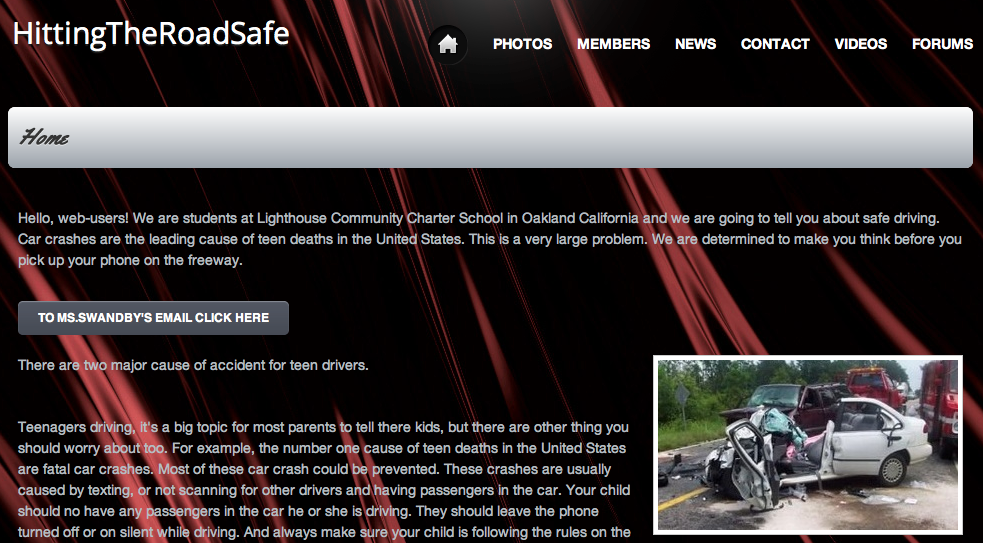
Melanie Swandby, a 7th grade teacher at Lighthouse Community Charter School in Oakland, CA was conducting a service learning project geared toward promoting safe driving habits. Melanie was happy to explore digital content creation with her students, extending her original vision for the project with the goal of producing clear and coherent writing in which the development, organization, and style were appropriate to task, purpose, and audience (CCSS Initiative, 2010). She invited Heather Cotanch and I to explore the use of iPads to create digital products that would resonate with teens and the wider community. We were excited to witness the content creation process which included elements of collaboration, experimentation, and flexible grouping to support peer facilited tech-help.
Why Digital Content Creation?
Digital tools are transforming what it means to be literate in today’s world. In the past, it may have been that decoding words on a page was enough to consider a student literate. Today, we live in a world with ever increasing importance on digital tools and technologies as a means of accessing and sharing ideas. Students need to become facile with the full range of communicative tools, modes (oral and written), and media. Having the ability to comprehend, critically respond to, and collaboratively compose multimodal texts will play a central role in our students’ success in a digital information age (Partnership for 21st Century Skills, 2007; IRA, 2009).
Setting the Context for Digital Content Creation
Melanie’s class worked to actively create projects that resonated with their intended audience without needing elaborate direction with the use of iPad apps. First, we provided a basic overview of the affordances of three digital composition apps (ShowMewww.showme.com, VoiceThreadwww.voicethread.com, and iMovie for the iPadwww.apple.com/ipad/from-the-app-store/apps-by-apple/imovie.html – these three content creation apps were chosen because they allow users to integrate still images, include a drawing tool, and have the capacity to include voice and sound effects). Then, we shared an example product from each app and students were off and running. They soon discovered many features of the apps themselves as they worked. This new knowledge was distributed throughout the classroom as peer support and flexible grouping was implemented.
iMovie. While using iMovie, students worked in groups and took on different roles such as creators, actors, and editors. Collaboration came in many forms, for example, some students did not want to appear on camera, but were willing to write a script and film a partner.
Other groups took turns incorporating found pictures and discussing sequencing to communicate a strong, clear message. Because of the ease of use and multiple options within the iMovie app, the editing process can become never ending. To support a more skilled use of the app, we pointed students toward a YouTube editing tutorial. Students who found themselves with extra time added captions or experimented with the background music offered within the tool. These “extras” gave the movies a professional feel while extending the students’ knowledge of the technology and supportive the processes of reflection and revision. While the iMovie app proved easy for students to navigate, explore, and edit, teachers would be well advised to guide students through ample planning of their project during their first few interactions with this tool.
ShowMe. Possibly the greatest successes were achieved with students use of the ShowMe app. Like iMovie, it produces a video, but its affordances allowed students to deliver the most complete, succinct messages of all three tools (student work is available at showme.com under the username jill.castek@gmail.com and password safedriving). During the showcase at the end of the project, the student audience commented on the ability for students to appropriate humor about a serious topic to be showcased. This was achieved through the use of voice, drawing, and integration of selected images. This app has limitations in the amount of media that can be uploaded and may have prompted the students to choose wisely from their options, making the message clear rather than being lost in elaborate visuals.
From the first introduction of this app, the students demonstrated an eagerness to peruse the tools and begin incorporating images, drawing and voice together rather than compiling images for a later use (a pattern we noticed with other tools). Even after several projects were lost due to glitches with the system, students simply started over learning from their mistakes, making strategic use of the drafting process, and integrating their new knowledge into final products.
VoiceThread. This tool offered the most structured means of conveying ideas and the students took to the tool readily. Once slides containing images were created, they could be moved around as the message was drafted and revised. Once sequenced, students could voice over the visuals to communicate their message. Completed VoiceThreads can be viewed at https://sites.google.com/site/swandby/safe-driving-voicethreads.
Students created multiple drafts of their VoiceThread project and practiced their voiceover several times to ensure the tone and quality of the message was spot on. Unfortunately, the VoiceThread interface selectively saved some of voiceovers, which required students to re-create their projects more than once. However, this redrafting wasn’t something students balked at and the message conveyed in each subsequent draft was more extensive, and richer in vocabulary and details. The limits of the technology were not discouraging, but rather a valuable introduction to the process of creating technology-based multimodal products.
What Did We Learn?
Students completed projects included a logical sequence but also incorporate personal touches through the use of music, voice, sound effects, and pictures remixed and used in creative ways. By including a specific focus on intended audience, Melanie’s students were readily able to form and frame a persuasive message. For example, students who chose parents of teen drivers as the target audience drew on experiences from their out-of-school lives and combined them with statistics from a school-based text. This resulted in charts and graphs representing percentages, an articulated message free from teenage jargon and pictures free from gore (as opposed to an increased shock value to presentations geared toward teen drivers).
Collaboration is key. Collaboration was widely fostered by encouraging students to turn to each other as resources and to help each other figure out how to accomplish their goals. For example, one group of students was using the ShowMe app and wanted include text in their presentation (there is no feature in which students can type using a keyboard). Students offered each other a workaround demonstrating the use the notepad feature and taking a screenshot to import it into the project. Other students offered another option and hand-wrote text on a piece of paper in bold marker and took a picture to import into the project. Still others shared how to use their finger to write the message manually. As was the case here, students often knew what feature that they wanted and found innovative ways to use the app to meet their goals. These observations reinforce the idea that step-by-step instruction by a teacher is not necessary before students use new apps. We discovered taking the time was not worthwhile and may, in fact, detracted from the collaborative and discovery nature of the work and curtail digital competence.
Time for experimentation is vital. We recognized at the outset of the project thatstudents were eager to learn how to use the apps offered to them in the act of content creation. While our instincts told us to model for students, it became increasing clear to us that experimentation with the apps supported student learning much more efficiently. It became evidence that when technology is being used, a new role for the teacher is created. She is no longer the “sage on the stage” and must be more comfortable circulating to support implementation by being the “guide on the side.”
Creativity and humor were strategically to convey ideas. As students created their projects, they infused persuasiveness through their use of creativity and humor. Creativity extended well beyond being able to draw well. When asked to reflect on the project, students reported being more engaged in the digital creation process, than the paper and pencil task (even though they needed to develop digital skills quickly to use the tools). They also enjoyed viewing the projects created by other classmates (even though they were very familiar with the content contained within them). Students created multiple digital drafts of their project (and were glad to do so). They appeared to use the multiple drafts to improve the project iteratively. If a student wanted to revise or rethink a portion of the digital creation, the opportunity to do this was manageable as opposed to the static poster version from which the students began. As pairs worked collaboratively, new ideas for improvement were shared amongst partners, which led to subsequent (improved) drafts. Even though students might have stumbled through the first couple of tries, they got better at it each time. Persistence was key!
Student Insights
Through the implementation of this project, we aimed to test a process by which students could create digital products (including drawings, images, and voice) that could be shared with a school and community audience. At the end of the project, students were asked to share what was different about digital content creation. One student remarked, “It’s more creative and more fun to play around with. It’s more exciting. You can put your voice into it and you can make it more fun.” This student aptly points out that digital projects are flexible. If a student wants to revise a portion of the digital creation, this is manageable. In contrast, changes on a static page can be messy or difficult and offer little room for rethinking of an idea. Another student shared, “You can use funny pictures but you can still have a serious message.” This learner points out that students could develop and incorporate their own multifaceted literacies. Although humor was never mentioned as a component of the project, students freely infused their personalities through media to reach their intended audiences on a level that demonstrated a high degree of literacy skill. A third student pointed out, “It’s a lot faster than when we usually do projects, you can write in different ways like voicing your message.”
Communicating with a Real Audience
In viewing the final projects, the audience (made up of members of the school and community) found the addition of suspenseful music, images, and the story-lines conveyed through multiple modes generated a tangible impact that was memorable. Witnessing the audience’s reaction interaction was one way that the students owned their success. It was clear that all students felt accomplished and through the act of digital content creation, they became more skilled in the digital literacies that are a vital part of our 21st century world.
References
Common Core State Standards Initiative. 2010. Common Core State Standards for English Language Arts and Literacy in History/Social Studies, Science, and Technical Subjects. Available at http://www.corestandards.org/assets/CCSSI_ELA%20Standards.pdf
International Reading Association. (2009). Integrating literacy and technology in the curriculum: A position statement. Newark, DE: International Reading Association.
“In order to be read, a poem, an equation, a painting, a dance, a novel, or a contract each requires a distinctive form of literacy, when literacy means, as I intend it to mean, a way of conveying meaning through and recovering meaning from the form of representation in which it appears.” (Eisner 1997, p. 353)
It has been 15 years since Eisner eloquently reminded us that we are moving from a text-based world to a multimodal one where we learn to learn from a fresh variety of sources and communicate generatively with a vast array of tools at our disposal. Schools around the U.S. have not always been quick to adopt such new tools and in some cases have moved to discourage the use of new literacies and evolving technologies in the classroom. In other places, such technological innovation is not only welcomed, but also supported.
We find a welcome case of such support in Napa, California, where a non-profit institution, NapaLearns (napalearns.org) has become a benefactor of technological innovation, providing grants to schools in the area for the purchase of tools and training. You may learn a great deal about the efforts of NapaLearns by visiting their website.
Here I would like to highlight one of the projects that NapaLearns funded. The project takes place in a public school and in the Kindergarten classroom of a very talented teacher, Ms. Martha McCoy. Martha and I became acquainted through her graduate program in Innovative Education at Touro University, where I taught research methods last spring.
In Martha’s words:
This year our kindergartners embarked on a great journey to explore the ways technology can be used to enhance their learning. In addition to crayons, paper, pencils, playdough, puppets, puzzles, play, manipulatives, and realia, we are learning with iPads.
Our students are primarily English Language Learners, 100% of whom are living in poverty based on qualifying for free or reduced lunch. Less than 2% of the students’ parents graduated from high school in the U.S. and 17/18 students only speak Spanish at home. These students are at the greatest risk of school failure.
The strategy for use of the iPads was to provide early academic intervention focused on building English language vocabulary and school readiness in our most ‘at risk’ students. The iPad enhanced kindergarten project began as a partnership between NapaLearns, a nonprofit organization, Calistoga Family Center, a family resource center, and Calistoga Joint Unified School District. The partners share in NapaLearn’s mission to “re-imagine learning for all children in Napa Valley …to promote implementation of education innovation and promote student- centered 21st century learning…so our students can compete in a fast paced technology enhanced world.” (NapaLearns Mission Statement, 2010).
********
Martha completed an action research report to ascertain the effects of a partnership in her school between her kindergarteners (who knew iPads) and 6th graders at the school (who knew about writing). The Kinders and the 6th graders worked in cooperative pairs to create comic strip posters to show preschool children (who would be in K the next year) what a typical day in Kindergarten looks like.
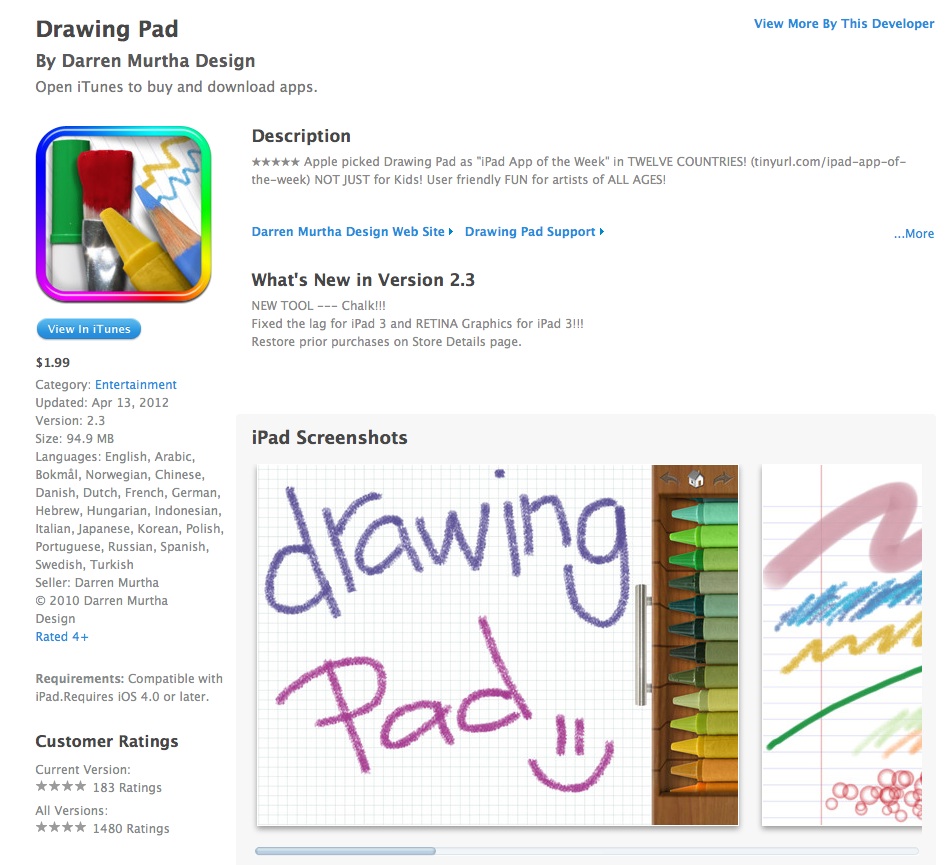
The Kindergarteners used their iPad cameras to take pictures of typical scenes in a Kindergarten day. They also drew pictures using Drawing Pad (see screen capture below).
The drawing pad application costs $1.99 and I purchased it to try it out. Don’t laugh (I’m not an artist!), but learning the program was simple and here is a terrible example.
For those of you who know my husband, Marc, he is well represented by a firetruck (we own one from 1949). Me, I’m always up in the air.
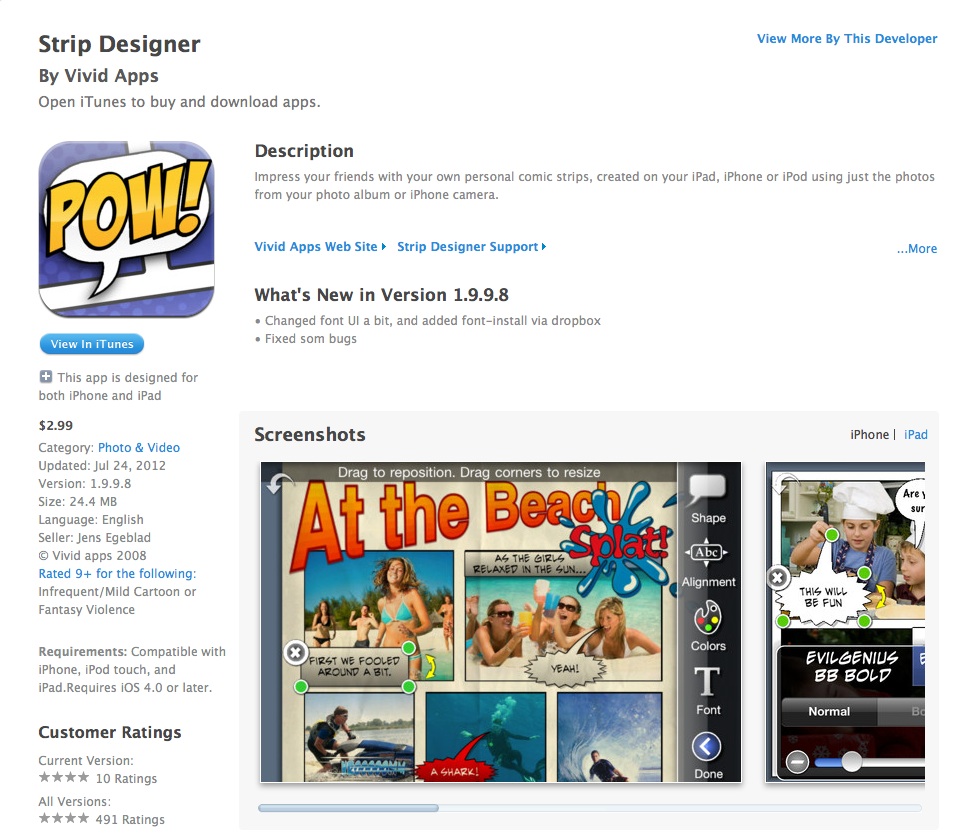
The students put this photos and text together using another iPad (and iPhone) application called Strip Designer (see screen capture below). This program costs $2.99 and I also downloaded and tried it out using photos.
Strip Designer also has a tutorial and is relatively easy to learn. I’ve done a couple of the comic strips, but instead of sharing mine, I have Martha’s permission to share one her student did:
But probably the best way to get the essence of Martha’s work is to view her Animoto on the project, also created for the Innovative Learning program at Touro (under the auspices of Program Director, Dr. Pamela Redmond). You can view this at http://animoto.com/play/xLgpKJU7wrQjLe1qaVfWuQ.
One project is complete, but new learning continues. Martha is busy planning new efforts for this academic year. She has already designed lessons on digital citizenship for the K-6 team. She plans for 6th graders to learn about Internet safety, cyberbullying, and respectful (and responsible) digital behavior to prepare for teaching their Kindergarten buddies. Then they will design posters, digital books, and skits with their Kindergarten buddies about how to be safe and respectful online. Martha plans to weave elements of Internet safety throughout their projects all year long and build it into their rubrics.
I can hardly wait to see the results!
In the meantime, I am planning a little research of my own with the collaboration of four high school teachers who will use Strip Designer to scaffold the literature they will be using in their classrooms. Much more on that later.
There are so many ways that the above two inexpensive programs can be used to scaffold our students’ learning. The Drawing Pad art can be emailed and archived, as well as placed in “albums” and books to be viewed online or printed out. Strip Designer is very productive also. I have written before with colleagues on the uses of graphic novels in special education (Smetana, Odelson, Burns, & Grisham, 2009; Smetana & Grisham, 2011), while having used them with mainstream classes. Storyboarding and graphic novel writing is made easy with Strip Designer. There must be many more uses of this that readers of this blog can envision! A very positive part of this is that one iPad can be used to do all of this. Martha has iPads for all her students, but even if you have one in your classroom, you can provide enormous benefits to your students with very little expenditure.
What are YOUR ideas for using these new tools? All ideas and comments are very welcome!
References
Eisner, E. (1997). Cognition and representation: A way to pursue the American Dream? Phi Delta Kappan, 78, 349-353.
Smetana, L., Odelson, D., Burns, H. & Grisham, D.L. (2009). Using graphic novels in the high school classroom: Engaging Deaf students with a new genre. Journal of Adult and Adolescent Literacy, 53, 3, 228-240.
Smetana, L. & Grisham, D.L. (2011). Revitalizing Tier 2 interventions with graphic novels. Reading Horizons, 51, 3.
Digital tools can promote collaborative and social learning opportunities, enhance literacy development and extend the boundaries of the classroom. Digital tools can be used in ways that support receptive, expressive and generative processes. This coming semester I want to explore, with my teacher candidate students, the possibilities presented by a range of digital tools. In this post I will explore the possibilities presented by Voicethread and Thinglink
Voice Thread
Voicethread for educators (http://ed.voicethread.com/#home ) provides an interactive online forum for conversations and student collaboration. Voice threads are collaborative multimedia slide shows which integrate images, documents, and sound files. A voicethread workshop, with easy to follow instructions of how to create a voice thread, can be found here or you can view online tutorials.
Voice threads allow for anytime, anywhere conversations, and allow participants to annotate and comment asynchronously in five different ways: using voice (via a microphone), text (using a keyboard), audio file, video (with a web cam) or annotation through doodling. Participants click on ‘Record’ or ‘Type’ to add a comment which then appears around the border of the image, slide or video. Teachers can create free education accounts for their students. Participant identities are represented through images or avatars (created in for example, Doppelme.com) which are added to the accounts. The interplay of multimedia and commentary are essential parts of the process and encourage student response. Students can respond through for example, asking questions; offering opinions; or making text-to-self, text-to-text or text-to-topic connections.
At voicethread4education wiki (http://voicethread4education.wikispaces.com /) you can view 26 different ways to use Voicethread for language arts and the content areas in the classroom.
Here are some of my favorites for language arts from the list:
#1 A mystery scene: What is happening and what might have caused it? What vocabulary can be used to describe the scene?
#5 Video : view, comment on and review a short video. For example, comment one of the vocabulary videos produced by the class group.
#7 Novel: comment on a character or protagonist from a novel.
#10 Inferencing: what were they thinking? Providing an image from the creative commons on Flickr and asking students to comment. Great for developing inferencing and reinforcing vocabulary.
#14 Digital Portfolio: Students could create a digital portfolio using images video and text.
Thinglink
Thinglink (http://www.thinglink.com/ ) is a digital tool that allows students to explore topics through collaborative discussions. Students can insert interactive links to tag an image by adding pop up multimedia hot spots. Hotspots can link to music, audio files, video, descriptions, definitions or quotations.
Thinglink Hot Spots for the target word Perseverance include a dictionary definition, a quotation using the word and a short video showing how people from a range of backgrounds (e.g. sports, music, politicians) persevered against the odds. You could also add examples for the target word used in a context, an audio file for pronunciation (great for English Language Learners), or a vocabulary video to illustrate usage ( Bridget previously blogged about vocabulary videos on Literacy Beat ).
A photo collage created in Photovisi (http://www.photovisi.com /) could be created by groups of students to tag each image with a pop up of descriptive adjectives, synonyms or antonyms. Further information on Thinglink can be found on Donna Baumbach’s list of ways to use Thinglink in the classroom on Google docs or alternatively you can visit Pininterest to view how teachers have used Thinglink in the classroom here
So in the dying embers of your summer vacation do take time to mess around, play with and explore the possibilities presented by these digital tools to enhance literacy development in your classroom. Happy exploring! Good luck with the new semester!
Dana Grisham and Thomas DeVere Wolsey’s new book, “Transforming Writing Instruction in the Digital Age: Techniques for Grades 5-12”. is a wonderful resource for all of us who are striving to integrate technology and writing instruction in ways that make a meaningful difference for our students. I was honored to write the foreword for this outstanding volume and have provided it below for your information. I’ve been re-reading the book in preparation for the fall semester and was struck by its timeliness and relevance to the Common Core State Standards. This adds even more to its value!
From Transforming Writing Instruction in the Digital Age: Techniques for Grades 5-12 by Thomas DeVere Wolsey and Dana L. Grisham. Copyright 2012 by The Guilford Press. All rights reserved.
Foreword
My friend calls out, “The water’s amazing! Jump in!” I hesitate. “Hmmmnn, shall I? It looks cold. Are those clouds on the horizon? I like to swim, but snorkeling is relatively new to me.” I stand at the edge of the dock, watching my friend enjoy herself. I know she is an experienced snorkeler and this is one of her favorite spots. I grab hold of my gear and step off the edge. “Okay, here goes, I’m JUMPING! Wow, this feels great!” And away we go, my friend and I, swimming over the coral reef, ready for an adventure together.
Thomas DeVere Wolsey and Dana L. Grisham have written a book about technology and writing that invites us to “Jump in!” and join them in the adventure of integrating technology into the teaching and learning of the millennial generation. They invite us to jump (or step, if you are feeling a bit more cautious) into the exciting and sometimes turbulent waters of teaching writing in today’s schools. They guide us to focus on what’s important about writing, learning, and the role that technology and media can play in improving the quality of our students’ compositions, their use of writing to transform learning, and their engagement with academic literacy.
Leaders in the scholarship and practice of digital literacies, DeVere and Dana are expert guides who share the wealth of their knowledge and experience in this book, which is designed to help teachers take the next step forward in using technology to engage students in writing that is worth doing. The book artfully combines theory and practice, presenting numerous examples and vignettes to offer a vision of what is possible, along with the concrete suggestions and practical tips that are essential to success. I had barely started reading the manuscript and taking notes to prepare me for writing this foreword when I found myself opening a second document file to take note of teaching ideas, digital tools, and resources that I knew would be useful to me in my own work. The book had a larger effect on me, how- ever, stimulating my thinking about our underlying models of composition in a digital world and the urgent need to improve both theory and practice. It also reinvigorated me. The status quo is not working for too many of our students. It’s not working for many of us who are teachers. Using technology to help students create, communicate, connect, and learn is one way to change things. I believe that teachers, literacy coaches, teacher educators, and curriculum specialists will find this book to be a valuable resource, one that provides multiple entry points and pathways to follow in accordance with their individual goals, subject areas, and levels of technology expertise. In the following section, I highlight some of the key features of the book that I think make it a particularly valuable resource.
Student learning and writing pedagogy drive technology integration, not the other way around.
I love “cool tools.” In fact, my colleague Debbie Rowe and I lead a multimodal composition research group for doctoral students that begins each session with one of the members sharing a digital tool that has interesting implications for research and practice. DeVere and Dana offer a rich array of digital tools and resources throughout their book. However, it is abundantly clear from the Introduction through to the last page that their book is about writing, is about learning, and is about engagement. Technology and media are essential to making that happen. We need the nuts and bolts to build something, but we also need to have a vision for what we’re building, to understand why it’s important, and to know how we go about constructing it. Before we begin, we want some evidence that what we’re doing is supported by previous experience and success.
Dana and DeVere set their vision in the Introduction and then extend and apply it in each chapter. They draw on Bereiter and Scardamalia’s (1987) models of writing as either “knowledge telling” or “knowledge transformation.” While they acknowledge the role of “writing to tell,” their passion is in helping students use writing for knowledge transformation. I appreciate the way they structure each chapter to open with sections on “What is it?” and “Why is it important?” before moving on to how technology can help. Theory and research are embedded throughout (and where the research is limited, they suggest practices that are promising). The continuing message is that technology is both medium and message, and that it is their particular use by knowledgeable teachers and their students that will move us forward.
Writing is not just for English; writing is discipline specific.
Often there is a divide between folks who love to teach writing for literary purposes and those who love to teach their content and view writing as a vehicle to communicate learning. DeVere and Dana offer a more integrative perspective. They make a strong case for why writing is part of academic literacy. Writing is not just a matter of genre and text structure; rather it’s a way of thinking and using language and symbol systems to communicate within our community. A real strength of this book is the range and depth of examples from English, social studies, and science classrooms that illustrate how technology and media can transform the learning process and offer new opportunities for students’ creative expression, social interaction, and learning. Students compose to grapple with challenging content and accomplish purposes specific to the subject matter. While composing tools might be considered somewhat generic, Dana and DeVere illustrate how it is what you do with them in relation to particular academic content and skills that can make all the difference between a “just okay” and an “amazing” student- learning experience and outcome.
We’re all in this together, or teachers and students are making it happen.
In public speeches about educational reform and in professional devel- opment efforts, we often hear that teachers are leaders and that our notion of “what works” should expand to include practitioners’ expertise and expe- rience. The democratization of publishing on the Internet has offered many teachers the opportunity to communicate directly with an audience that is interested in learning from and with them as they go about the daily work of teaching in schools. Blogs, websites, and wikis are just a few of their online venues. However, teachers’ voices are less well represented in published text- books. One of my favorite features in this book is the inclusion of in-depth classroom examples in each chapter. Some examples are written by teachers, whereas others are written by DeVere and Dana at a level of detail that shows their intimate knowledge of the teacher, his or her classroom, and students. It is the combination of Dana and DeVere’s expertise with the expertise of some amazing classroom teachers that give this book depth and credibility.
Affect matters—for students and for us.
Have you ever taken a course or a workshop because of the way the instructor teaches, as much as the content of the course? The importance of affect and the social basis of learning is just as true for adults as it is for children—perhaps even more so, since we bring firmly entrenched beliefs and dispositions along with vast stores of knowledge and skills to each learning encounter. Clearly, DeVere and Dana are highly expert and experienced in the field of writing and technology and there is much to be learned from the information in this book. They are somewhat unusual, I think, in the way that they have shared some of who they are through their writing of this book. Their writing style and tone are conversational as they think out loud, conjecture, joke, and share strong feelings and convictions. They respect teachers and children. They understand and have experienced the realities of real teaching, real kids, and the unpredictability and promise of teaching with technology. They are resilient and hopeful about the future of students in our schools and the role of technology and writing in making change happen. By the end of the book, I was very glad to have had Dana and DeVere’s guidance and to know that they are continuing their adventures in writing and technology. Jump in and try an adventure of your own—I know I will.
Lit Beat is back in action! It’s wonderful to have had a bit of the summer to relax, refresh, and explore new ideas. Wishing you an upcoming school year filled with promise. I hope this post sparks your thinking. Please post a comment to share additional connections or implementation ideas. We look forward to hearing from you!
Supporting English Learners’ Literacy Development in a Digital Age
The diversity present in our classrooms requires us to think differently about the literacy instruction we offer our students. We need to offer new opportunities for students learning English to enhance and extend their language, literacy, and content learning. This new post suggest ways to (1) use digital videos and animations to promote students’ vocabulary development and content knowledge, (2) use bilingual texts to encourage language and content learning across the curriculum, and (3) involve students in sharing ideas with the aid of digital tools.
Using Digital Videos and Animations to Promote Vocabulary Development and Content Knowledge
ELLs benefit from a multi-faceted approach to learning that makes use of interactive visuals. The Internet offers easy access to a great many of these visuals across a range of topic areas. Providing students opportunities to view media that presents ideas both textually and visually creates a meaningful learning context that supports the acquisition of academic vocabulary in writing and speaking (Dalton & Grisham, 2011). Using digital resources brings concepts to life for students. Pairing them with opportunities to read, write, and share ideas helps support and enhance ELL’s content understanding.
Children of all ages and backgrounds seek to better understand the fascinating animal species found in our world. The Monterey Bay Aquarium, home of several sea otters and other marine creatures, makes reading about animals an adventure. The Sea Otter Interactive http://www.montereybayaquarium.org/media/all_about_otters/whatsanotter01.html is one of many resources that will spark students’ curiosity about the natural world. The visual support offered by the animated otter, along with the illustrative diagrams and animations, provides visual support that aids students in making connections across languages.
Sea Otter Interactive developed by the Monterey Bay Aquarium
Providing opportunities for students to discuss the interactive in their native language before participating in whole-class discussion can reinforce these connections. The native language discussion serves as a form of language rehearsal where students can organize their thinking, plan, test their ideas, and make appropriate revisions before sharing their thoughts with the whole class. Discussion techniques such as Turn and Talk or Think-Pair-Share are some examples of ways to provide opportunities for language rehearsal.
When introducing a new interactive to your class, set up a digital projector and talk through one part of the resource as a demonstration while generating guiding questions together as a class. Then, offer students time to explore the digital resource in small groups during literacy center time. This second self-guided viewing will provide a means to read for a purpose, investigate the questions posed, and deepen students’ interest.
Below is a brief list of videos and animations that connect to common content topics covered in elementary and middle grades:
To locate additional resources in curriculum areas you teach, search Google by typing in your topic area + interactive (e.g. solar system + interactive).
Using Bilingual Texts to Encourage Language and Content Learning
Effective literacy instruction makes connections to students’ linguistic, literacy, and cultural resources. These resources can be used to support learning in their second language. Utilizing educational resources in both languages builds students’ cognitive flexibility and increases meta-linguistic awareness (Gort, 2008). Bilingual websites such as Monterrey Bay Aquarium’s Pup’s Supper/La Cena del Cachorro http://www.montereybayaquarium.org/lc/activities/book_pups_supper.asp encourage home school connections and encourage learning across the curriculum.
Bilingual English/Spanish e-book about Sea Otters developed by the Monterey Bay Aquarium
NASA’s Sun-Earth Day Multimedia Children’s Books http://sunearthday.nasa.gov/2006/multimedia/books.php are free animated multimedia books that present concepts both visually and textually. Because these resources make it possible to see and experience phenomena such as aurora, they support the development of language, literacy, and content simultaneously. Accessible in both English and Spanish, each book poses essential questions and presents concepts that help students address them. Related resources such as an image gallery and dictionary, extend ideas presented in the text.
The Rainforest Alliance Virtual Story Bookshttp://www.rainforest-alliance.org/kids/stories offer engaging and colorful fiction and non-fiction books in three languages English, Spanish, and Portuguese. These texts engage young readers by introducing them to children who live in areas that surround rainforests. The imagery and first hand accounts captured in these unique texts make students more aware of these diverse environments and the wildlife that inhabit them. Exploring these engaging texts extends emergent bilingual students’ comprehension and vocabulary while helping them make connections between languages.
The International Digital Children’s Libraryhttp://en.childrenslibrary.org/ is a portal site that makes children’s books from around the world available in a variety of languages. Over 2,800 books are available in 48 languages, free of charge. The simple search feature makes it easy to find books that match the age range and interest level of all students. Each text includes a feature that allows the reader to switch the language for instant translation. Because the books on this website do not require a trip to the library, students can access them at school and at home.
Sharing Ideas with the Aid of Digital Tools
The Internet has made it possible to write in a variety of forms and reach a wide audience almost instantaneously. By introducing new outlets for sharing ideas, ELLs can make important connections between reading and writing.
Wordlehttp://www.wordle.net/ is a resource that makes it possible for students to generate word pictures using an assortment of words that they chose (in any language). How frequently the inputted terms appear determines the size, placement, and prominence in the final product. The interface eliminates common words such as “the” or “and” so that key words take on greater emphasis. The selection of layout schemes can be used to highlight ideas and relationships among terms.
This easy-to-use resource provides students a powerful tool for expressing their developing understanding of words, concepts, or ideas in a motivating and engaging way. For example, Wordle can be used to extend quick write activities. For example, after reflecting, students can be paired up in small groups to input their writing into the interface. Printing out students’ Wordles and creating a gallery walk can be a useful review and reflection activity to summarize what they have learned about a topic they’ve studied. Repetition of similar learning statements in this case would be beneficial since key concepts would pop visually and aid students in recalling important ideas. These alternatives for formal writing activities would also provide teachers a way to formatively assess students’ understanding of content studied.
ELL students can create Wordles in their home language. Below is one that Iliana created to reflect the concepts she had learned about the sun and its importance the solar system. She placed a tilde ~ between words that she wanted displayed together, such as sistema~solar so that these terms would appear side by side.
Iliana’s Spanish wordle about the sun and its importance the solar system
RealeWriter (“Really Writer”) http://www.realewriter.com/ is a free Web site that invites users to upload images or drawings, write their own text, and publish professional looking books that can be printed or posted online. Educators have used RealeWriter to author books collaboratively as a class project and also as a tool for individual student authors. Innovative educators all over the world have used these resources to help students express ideas. The ease of the software enriches the writing experience and helps English learners find their voice as writers. RealeWriter turns writing into an experience that is enjoyable, authentic, and social.
To get started with RealeWriter, explore the wide selection of student published books. Topically focused texts can be found by typing key words into the site-specific search engine at the top of the page. Clicking on the featured or popular books tab to view examples that will appeal to all ages and interest levels. El Mercado is a delightful Spanish/English bilingual book that takes readers on a trip through a market place in Mexico City in search of a birthday present for six-year-old Sean.
Reflecting on Implementation
As new technologies continually emerge, new skills and strategies will be required by students to effectively make use of them. Though many teachers have yet to possess these skills themselves, it is nonetheless our responsibility as educators to provide an educational context in which all students can acquire them. Extending these digital learning opportunities is central to students becoming participatory citizens and achieving success in school, higher education, and the workplace.
References
Dalton, B. & Grisham, D. (2011). eVoc strategies: A dozen ways to use technology to build vocabulary. The Reading Teacher, 64, 306–317.
Gort, M. (2008). “You give me idea!”: Collaborative strides toward bilingualism and biliteracy in a two-way partial immersion program. Multicultural Perspectives, 10(4), 192-200.
Since my retirement from the California State University in 2010, I have become a self-styled “Internet Freeway Flier.” A freeway flier is what we used to call instructors who were employed part-time by several community colleges or universities. Those intrepid individuals “flew” over the freeways of Southern California from one assigned class to another. I like teaching online—although I also like teaching in the brick and mortar university—so in the past two years, I have been asked to teach online classes at five different universities in five very different programs. Each assignment has allowed me to investigate the intersections (pardon the pun) of literacy and technology.
Most recently I was asked to teach an online supervision course in the Reading Language Arts Authorization (RLAA) program at Fresno State University. The RLAA is a graduate level literacy program designed primarily for experienced teachers as part of a larger Master of Arts in Teaching program. Usually, teachers come to a brick and mortar clinic where children also come to be tutored. The teachers are supervised by university faculty to make sure that they learn how to assess the students, how to address students’ identified strengths and needs through tutoring, and how to evaluate the outcomes of instruction in order to plan their next instructional steps. This recursive process requires feedback from the supervisor to the teachers. I have taught in such brick and mortar clinics before.
In this case, Dr. Glenn DeVoogd, Chair of the Literacy and Early Education (LEE) program at Fresno State asked me to do an experimental class, which he and I will be writing about at length in other venues. But for this blog, I’d like to immediately share how this course was structured, how teachers responded to it, and what they say they learned from the process.
Teachers were enrolled at Fresno State in a course, LEE230, which used to be taught on campus. This class was taught in a 5-week time frame, so the pace was intense, and the teachers and I never met face-to-face. Teachers were required to spend 20 hours of tutoring a small group of students. Instead of coming to a clinic, teachers could select the small group from their own classrooms, from that of another teacher, or volunteer in a classroom if they were not currently teaching. All of these scenarios played out during the course.
Teachers turned in weekly lesson plans twice; on the Sunday before the school week and Friday or Saturday, after the school week, they re-submitted the same lesson plans with detailed reflections on their teaching. We met twice on Elluminate for class sessions to talk about readings. Students participated in discussion boards on pertinent topics and did a WebQuest (https://literacybeat.com/category/webquest/) on the CCSS.
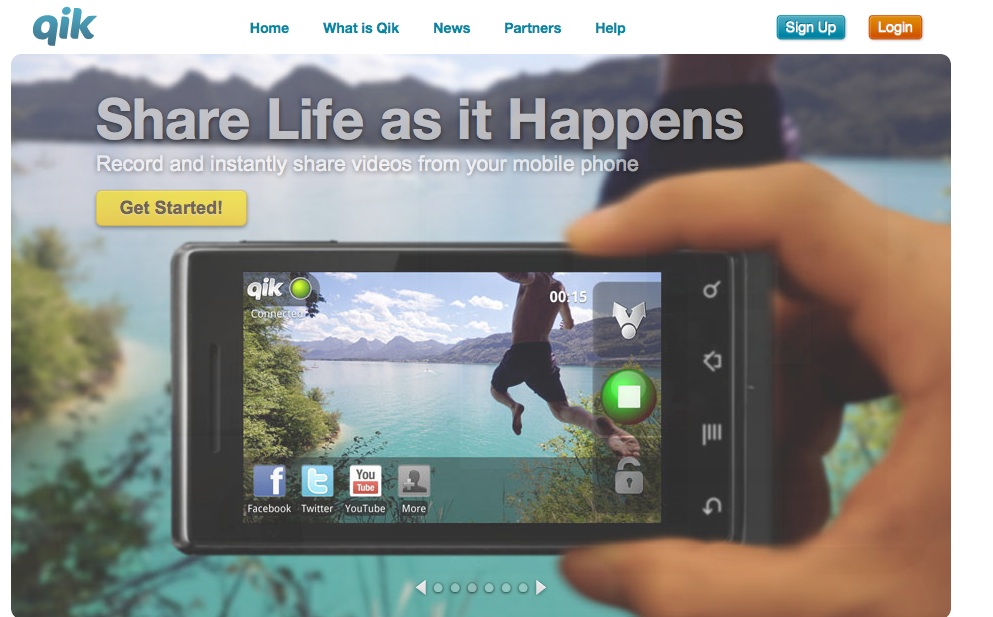
But the centerpiece of the clinical course was the use of a smart phone application, known as Qik (http://www.qik.com) which teachers used to record 5-10 minutes of a lesson three times over the five-week course.
About Qik
Virtually every smart phone is supported by Qik and there is a published list of those on the Qik website. You can pay for Qik, but the free application allows you to store 25 videos, more than enough for our purposes. You can also use Qik on your iPad.
Teachers could point the phone and press record and make a video immediately. The videos are directly uploaded and stored on the teacher’s Qik site, which is totally private, and teachers can invite others to view their videos in several ways—for example, videos could be shared via Facebook, Youtube, or Twitter. For this class, teachers extended an email invitation to me so that I could view their work.
Prior to the start of class, I sent a Qik introduction of the course to all the teachers enrolled before class began.
Students found it easy to make the videotapes, but capturing the lessons was more difficult unless they had someone to help them. For example, one teacher propped her smart phone on the table, but the student got enthusiastic, knocking against the table and the phone fell over. After two times, the teacher asked the student to be careful. Another teacher held the phone herself and only videotaped her students.
Other teachers asked students to hold the camera on the action and the example you will see enlisted the help of a fellow teacher.
Once students learned how to share the videos by email invitation (see the double arrow at the top of the figure below), I could access them and provide a response.
Responses
Interestingly, the responses I provided were much appreciated by the teachers, who loved the personal nature of audio (MP3) files. Previously, in this blog I have shared teacher candidate podcasts (https://literacybeat.com/2011/04/15/podcasting-to-teach-content-literacy) and in another project special needs students made audio retellings of a folktale in a PowerPoint presentation (Castek, Dalton, & Grisham, 2012), so I had some experience with making MP3 files.
But none of us likes what we look like on video or sound like on audio. I am no exception! So I gathered up my courage and decided to give audio responses to teachers’ lesson videos.
Being a Mac user to the core, I employed Garage Band to record my responses. First, I watched the teachers’ videos and made notes. I compared what I had seen in the video to the written lessons the teachers had posted in advance to Blackboard. Then, I recorded the responses, which varied from about 90 seconds to almost 4 minutes over the three videos submitted by all 13 of the teachers for a total of 49 responses overall.
Once the recording was made in Garage Band, I “shared” it with iTunes, converting to the MP3 file format. Then I downloaded the MP3 files and attached each one to an email to the teacher.
Based on questionnaires administered after the course, everyone LOVED the responses. They felt a connection. I believe that teachers need validation for the work they do. Teachers can also accept criticism, as long as it is couched in positive terms. Writing can be very impersonal, but the voice can convey support.
In response to the question about the MP3 responses, here are what two teachers wrote:
“Again, something new to me in this class, but incredibly useful. The audio feedback was terrific. It made me feel like I was in an in-person class. Very personal. I think every online class should have this.”
“I enjoyed being able to gain almost immediate feedback from the videotaped lessons. It was nice to know that someone with experience could see areas of concern and help me shape my teaching more effectively.”
An Example of the Lesson and the Response
Written permissions were obtained for students to be videotaped and the teacher whose videos you see here granted permission for me to share her video. The second file is the audio response to this lesson.
The growing number of online and/or hybrid classes is remarkable. Technology changes were referred to as “deictic” by Don Leu back in 2000 and deictic means a veritable onslaught of transformations that are irresistible and ever-evolving. Combined with an economic downturn and increasingly diminished higher education budgets, administrators may increasingly turn to the more economic option of online classes. It is popular right now to regard online classes as somehow “less” than brick and mortar classes, and in some cases this may be true.
But online classes offer access to many graduate students who cannot attend a brick and mortar university. In another course that I teach at a different university, a middle school teacher from Happy Camp, California (way up in rural Klamath County), was able to improve his practice by learning in an Innovative Masters Degree program that afforded him new ideas, new strategies, new collaborations with colleagues, and new ways to serve his mostly Native American population of students.
In addition, we have new technologies (such as Blackboard, Elluminate, smart phones, and applications of all kinds) that permit us to make the online courses more personal and more relevant to the students we teach. We can give of ourselves as teachers and mentors through these new technologies. Our students can benefit from what we do online, as shown by the reactions of teachers to the LEE230 class.
I am greatly interested in what others think about online learning and hope you will read this blog and share your own experiences!
There is considerable evidence that young children (aged from 0 to 6) are immersed in a digital world from birth. For example, surveys conducted in the U.K. revealed that young children were active users of digital technologies engaging in a range of multimodal experiences (Marsh, 2005).
However, recent research has highlighted a dissonance between technology use in the home and at school and indeed a general under-utilisation of digital technologies in early years classrooms (Aubrey & Dahl, 2008).
Given that young children are engaging with digital technologies and digital practices in the home the possibilities afforded by these early digital experiences need to be more fully explored and accommodated within the classroom curriculum.
So how can we utilise digital technologies in ways that support children as readers, writers and thinkers? How can we use technologies to support the development of essential early literacy skills and increase motivation and engagement with literacy and learning?
I have been reflecting about this recently and here are some tentative musings and suggestions.
• Young children should engage with digital literacies in ways that encourage “playfulness, agency and creativity” (Burnett, 2010). Indeed, research has shown that children can draw on narratives and characters from their use of multimedia in their own play (Pahl, 2005).
• Digital technologies should not replace ‘busy’ workbook type activities in the classroom in drill-and-practice type scenarios. Freddy Hiebert noted, in her Frankly Freddy column, that “tricked out rote exercises will not support children’s love of language and literacy in the long run” (Hiebert, 2012).
• Digital technologies and multimodal texts offer the potential to support the development of early literacy skills. They present multiple means of representation, provide robust supports to meet the diverse needs of pupils in the classroom, and reduce the barriers to text (e.g. decoding difficulties) through embedded supports. BookBuilder from CAST (CAST.org ) is a particular favourite of mine and I have previously blogged about how BookBuilder can enhance the Language Experience Approach
• Digital technologies should complement or supplement teacher read aloud. For example, children can listen to or re-read favourite class room texts though storyline online, developed by the screen actors guild (http://www.storylineonline.net/) or through apps such as, a Story Before Bed-Personalized Children’s Picture books.
• Digital technologies should build on the creativity of children, provide opportunities for engagement and response and encourage children to become authors and producers of text. In addition digital technologies should encourage experimentation and expression with regard to the generation and construction of a story or message. Apps such as, Sock Puppets allow child to create a story, choose a background and record their voices. The sock puppets then automatically lip-synch to the child’s recorded voice. Other examples include Strip designer, for creating comics; Book Creator for Ipad and Story kit for creating stories to share with an audience outside the classroom walls.
• Digital technologies can supplement the development of fine motor skills for handwriting. Apps such as, Dexteria, which was developed for children with special needs, develops fine motor skills e.g pincer movements, finger strength and hand movements and letter formation. Watch the You tube video and you’ll see how appealing this app is. I would caution, however, that to my mind, nothing replaces concrete materials, like pegs and peg boards, sand trays, and making letters with plasticine for the development of fine motor skills for handwriting.
Burnett, C. (2010). Technology and literacy in early childhood educational settings: A review of research. Journal of Early Childhood Literacy, 10(3), 247-270.
Marsh, J., Brook, G., Hughes, J., Ritchie, L., Roberts, S. Wright, K.(2005). Digital beginnings: Young children’s use of popular culture, media and new technologies. Literacy Research Centre, Sheffield
Pahl, K. (2005). ‘Narrative spaces and multiple identities: Children’s textual explorations of console games in home settings’ In: J. Marsh (2005) (Ed.), Popular Culture, New Media and Digital Literacy in Early Childhood, pp. 126-143.London: Routledge.
I believe in the power and relevance of multimodal composition and storytelling for today’s children and teens. My belief is not abstract – it comes from my work with students on different types of multimedia projects. I also enjoy experimenting with my own multimodal pieces, especially integrating text and images. However, I remain a novice in this arena, never losing the feeling that there is so much that I don’t know that could potentially be helpful to me, and to my students.
CNN.com’s iReport Toolkit
Thus, I love it when I find help from those who are expert at what they do! In this case, it is the reporters and staff from CNN.com who are sharing their expertise. As part of their participatory news initiative, CNN has developed an iReport Toolkit that is available online at http://ireport.cnn.com/toolkit.jspa. The goal of the toolkit is to help you “Tell your story like a pro”. Of course, for CNN, stories represent all kinds of genres – from the investigative news expose to the human interest story.
The toolkit includes four main sections, Storytelling, Photos, Video, and Audio.
To begin, start with the story to be told
These expert reporters and storytellers start with Storytelling — highlighting the ingredients of a good story and then offering key advice such as getting the basics first, attending to pace, and talking like a human being (that is my personal favorite!). Additional links expand on different aspects of storytelling, allowing you to pursue your own storytelling needs and interests.
Tell your story with photos, video, and sound
For each of the next three sections – photos, video, and sound – the CNN folks zero in on what is unique about that mode for storytelling and communication purposes. The storytelling guidance is integrally connected to technical advice, such as framing your shot, or audio recording in a place with a noisy background.
Get tips from the professionals
I especially enjoy the pieces that feature advice specific reporters and production staff. While researching for this blog, I found a piece, ‘Editing Video like a Pro’, by reporter/producer Brandon Ancil (http://www.cnn.com/2011/IREPORT/09/09/edit.video.bootcamp.irpt/). It caught my eye because I’m preparing to create a mini-documentary about two youth composing a digital story together. This is a new experience for me, so I’m eager to try out Ancil’s method for organizing his video during editing and production. I will let you know how it goes in a future post!
Use the iReport Toolkit for teaching and learning
This type of resource can be used at two levels – to support your own experimentation with multimodal composition and to support your teaching efforts. If you are teaching middle or high school students, your students will be able to read and use the site on their own, with your guidance as to which sections to attend to for their particular project. If your students are younger, much of the information is applicable, but you will need to apply it as appropriate for your students.
Try it and see! And, please share strategies and resources that you have found to be particularly helpful in teaching multimodal composition to your students.


 Bridget Dalton
 berdwyer
 Blaine Smith
 danagrisham
 jillcastek
 TDWolsey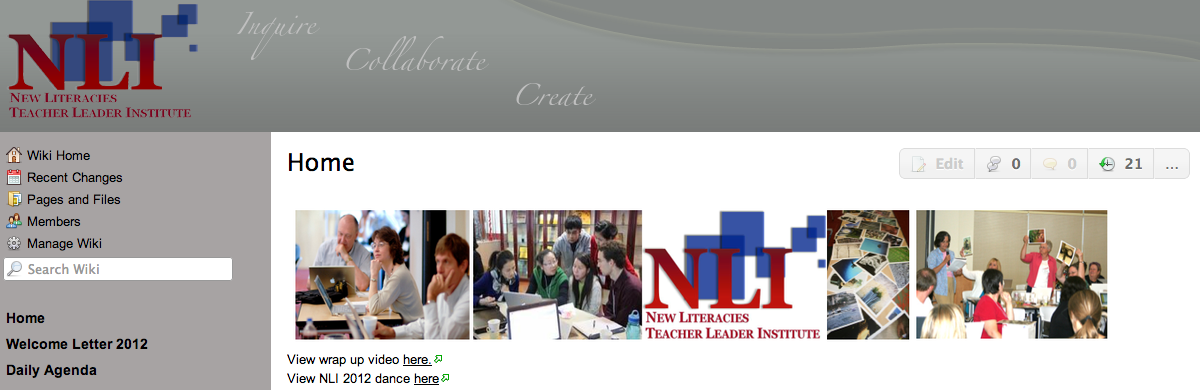







 on Amazon.





 Literacy Beat