Read Across America 2016

March 2 is Read Across America Day. Want to get involved? It’s easy!

Find resources, teaching ideas, and event planning tips on the NEA website and pledge to sponsor an event.

To keep the momentum going, March 3 is World Book Day. The World Book Day website if filled with great resources and toolkits.

Free Standard Shipping for all Book Orders Over $35 at The Scholastic Store Online! Shop now!

Online Resources for Argumentation and Logical Fallacies

By Thomas DeVere Wolsey

This week on Literacy Beat, I gathered some resources for teaching students to create and critique effective arguments. This list will appear in Literacy in the Disciplines: A Field Guide by Thomas DeVere Wolsey and Diane Lapp to be published by Guilford Press in summer 2016.

In the first section, you will find several resources that are useful across disciplines.  The second section includes argumentation resources for specific disciplines, such as science, social studies, and mathematics. Have you found useful resources for working with argumentation in your classroom? Please share them in the comments section, below, or send me an email.

General Resources:


Discipline-specific Resources:

From the Literacy Beat archives: See how we used the Visual Thesaurus in the Vocabulary Self-Collection Strategy Plus technique then visit their site. Just click the image below.

Education Dictionaries and Glossaries

By Thomas DeVere Wolsey 

In August, I published a post with links to discipline-specific glossaries and dictionaries. Because the internet has such a wealth of resources, it is sometimes difficult to find the sites you want or the key words for a search you need. Lists with links can help readers find the resources they need quickly. Continuing the dictionary list tradition, I compiled some general education dictionaries online. The criteria for inclusion are the same as in the discipline-specific post, except that the resource audience includes teachers and parents.

Parents may want to catch up on the words teachers use. Because schools and states purchase materials from different publishers, sometimes differing terms are heard in the faculty lounge or the school board room. The underlying ideas may be the same, but the word to describe that idea could differ from district to district.  Here are some resources to learn more about the words teachers use.

Reading Rockets

Reading Rockets

Language and teaching strategies: Effective teachers use a variety of strategies to guide their students. This glossary from Reading Rockets organizes them by the type of language learning task (phonological awareness, phonics, fluency, vocabulary, comprehension, and writing). http://www.readingrockets.org/strategies


Glossary of Language Education Terms

Wikipedia

English Language Learners: WikiProjects Glossaries provides this resource that includes terms used in teaching English language learners (students whose first language is not English). https://en.wikipedia.org/wiki/Glossary_of_language_education_terms

The United States Department of Education also publishes a useful glossary of terms related to teaching English language learners. http://www2.ed.gov/about/offices/list/ocr/ell/glossary.html 


Teachnology glossary

Teach-nology

General Teaching Glossary: General terms that go beyond those used just in language learning environments can be found on the Teach-nology site. http://www.teach-nology.com/glossary/


Fractus Learning Technology Terms for Teachers

Fractus

Technology in Education: As technology becomes an increasingly useful component for teaching, new terms have made their way into the classroom. Learn some of them on the Fractus Learning blog.    http://www.fractuslearning.com/2013/03/04/technology-terms-for-teachers/

Another useful site with technology terms, but not specifically for educators or parents, is Netlingo.com


Understood Disability Important Terms

Understood

Special education: The field of special education has its own set of terms, often derived from policies and laws that govern special education settings.  Look them up on the Understood website.          https://www.understood.org/en/learning-attention-issues/getting-started/disability-important-terms/terms-you-may-hear-from-educators


What other categories should be added to this link list? Are there other dictionaries or glossaries that you can suggest for any of the categories in this post?


Student Oral Language Observation Matrix: Spreadsheet Style

By Thomas DeVere Wolsey

A time-tested standby to help teachers understand English learners’ oral language proficiency is the SOLOM or Student Oral Language Observation Matrix. The instrument is not a test, but it is an informative assessment that teachers use to inform instruction. There are many versions in html, Word, and PDF, but an interactive version in Excel (.xls) may prove useful.

SOLOM and Excel

SOLOM is in the public domain, so you may find some variations in the various published versions of the Matrix.   Teachers and teacher educators use the Matrix, developed by the San Jose (California) Bilingual Consortium, for a variety of purposes:

  • It fixes teachers’ attention on language-development goals;

  • It keeps them aware of how their students are progressing in relation to  those goals; and

  • It reminds them to set up oral-language-use situations that allow them to observe the student, as well as provide the students with language-development activities.

    Source: Center for Applied Linguistics

Download SOLOM (Excel)

Download SOLOM (Excel) here.

The Box.net file opens in preview mode; to download, find the upper right ↓ download arrow. Figure 1 shows where to locate the download icon.

SOLOM (Excel)

Figure 1: Download from Preview Mode – SOLOM Excel

What are the advantages of the Excel version of SOLOM?

  1. You can replicate this SOLOM digitally without killing any trees (no paper needed).
  2. You can add sheets for each student to keep all your results in one file.
    • Each sheet is accessed by the tabs at the bottom, left, of the spreadsheet. See figure 2. This template includes three sheets, but you can add more if you need them. Start here to learn how.

      Excel Tabs

      Figure 2: Excel Tabs

    • If you choose to do so, you can calculate results across sheets – a topic for a future post.
  3. The Excel spreadsheet does the calculations for you, an important feature if you have many students’ results to enter.

Want to review some common Excel terms? Navigate here. Maybe you want to dive into Excel vocabulary a bit more deeply? Point your browser here.

SOLOM Practice on YouTube

Several good YouTube videos allow you and your colleagues to practice using SOLOM. Try this one. This Playlist may also be useful.

Excel Geek?

If you happen to be an Excel geek, you can read this paragraph. Otherwise, just skip to the “Sources,” below. Excel is a powerful spreadsheet that harnesses the calculating abilities of the processor on your computer (or in the cloud). This version of SOLOM employs the COUNTA function to actually count the number of entries for each column, the SUM function to add up the column totals, and the VLOOKUP function to assign overall scores to a proficiency level. Shout out to gebobs for helping me find the function I should use instead of the one I was unsuccessfully trying to use!

SOLOM Sources

The best original source for SOLOM I can find is found at http://www.cal.org/ and opens as a PDF.

I adapted SOLOM for Excel from Arch Ford Educational Service Cooperative;  in Word format at SOLOM. (note: I removed the word “even” from cell B8).

Please share your variations and adaptations of SOLOM (Excel) in the comments section. What might you do to improve this tool? How have you used apps other than Excel to improve SOLOM or similar assessments

Academic Vocabulary List

By Thomas DeVere Wolsey

For many years, the Academic Word List helped teachers and researchers determine which words were academic in nature (Coxhead, 2000).  Coxhead’s research resulted in the Academic Word List which comprises words roughly equivalent to Beck, McKeown, and Kucan’s (2002) notion of tier two words; that is, words that are used in academic English but not specific to any one discipline.  Coxhead created her list from a corpus, or collection, of academic texts from four disciplines at the university level mainly from New Zealand.  The corpus included 3,500,000 words in total. Academic words were determined by eliminating the 2000 most common words in English and then eliminating words which were found only in a limited range of disciplines.

Now, a new Academic Vocabulary List (AVL) is available online, and it is based on 120 million words derived from a corpus of texts in American English.  Linguists at Brigham Young University, Mark Davies and Dee Gardner, have made their work available as downloads you can use in your own research, or through an online interface. The online interface allows the user to search detailed information about any word in the AVL, and it also permits users to input an entire academic text to determine how it compares the words in the corpus.

This research directly informs instructional practices. An excellent article by Larson, Dixon, and Townsend in Voices from the Middle is a good place to start, and it is free on the National Council of English Teachers website (find the article How Can Teachers Increase Classroom Use of Academic Vocabulary? here and then scroll down the page : http://www.ncte.org/journals/vm/issues/v20-4)

Learn more about AVL on the List’s website at http://www.academicvocabulary.info/x.asp or visit the online interface by clicking the picture, above, or navigating to http://www.wordandphrase.info/academic/

References

Beck, I. L., McKeown, M. G., & Kucan, L. (2002).  Bringing words to life: Robust vocabulary instruction. New York: Guilford Press.

Coxhead, A. (2000). A new academic word list. TESOL Quarterly, 34(2), 213-238.

Gardner, D., & Davies, M. (2013). A new academic vocabulary list. Applied Linguistics, 1. Available: http://applij.oxfordjournals.org/content/35/3/305

Larson, L, Dixon, T., & Townsend, D. (2013). How can teachers increase classroom use of academic vocabulary? Voices from the Middle, 20(4), 16-21.

Literacy in the Disciplines: Getting at the Content

IAIE* created a webinar to connect teachers everywhere who are interested in learning more about what makes their disciplines unique. After all, learning in science is quite a bit different from learning in social studies and the literacies in those disciplines take on unique characteristics. Use the power of the web to connect with other teachers as we explore the disciplines.

The webinar is offered on October 8 at 4 PM  Pacific (7 Eastern) and a repeat is offered on October 14 at 1 PM Pacific (4 PM Eastern) for about 45 minutes.  The webinar is just $10, and you will receive articles and handouts, participate in a live presentation, and have access to a recording for future reference. In addition, you’ll meet some wonderful new colleagues. If you follow Literacy Beat, you may enter the discount code FRIENDS to receive a 20% discount before October 6.

Disciplinary Literacy

Disciplinary Literacy

*Full disclosure: IAIE is owned by Literacy Beat blogger Thomas DeVere Wolsey. While the webinar date has passed, it is still available by special request.

Writing and Technology: Free Virtual Conference

By Thomas DeVere Wolsey

The week of October 5 through 9, 2015, Turnitin is offering a free virtual conference on the topic of Writing and Technology: Exploring the Intersection as part of Student Success Week.  I will be one of the presenters, and perhaps I’ll see you in the webinar!

Writing and Technology

Student Success Week

There are several fascinating speakers, so register early. My session is

Writing and the Visual : Graphically Organizing Your Writing

Tuesday, October 6th 10:00am PST

And here is the abstract:

What if students could see how their writing is organized using graphics? It turns out that when they graphically organize their writing, students are more likely to write well, to compose their thoughts, and to try new approaches. In this session, Thomas DeVere Wolsey will discuss cutting-edge research on how visual organizers enhance writing and writing instruction.

Update: You can watch recorded sessions here: http://turnitin.com/en_us/resources/student-success-week

Zooming in on Vocabulary: Prezi and the Frayer Model

By Thomas DeVere Wolsey and Dana L. Grisham

Graphic organizers have helped many students grasp vocabulary for years. The most effective uses of graphic organizers require students to use vocabulary, often through engagement with text, peers, and teachers in multiple ways.  In other words, it won’t do for students to simply “complete” a graphic organizer. Rather, they must use the organizer to explore the concept or vocabulary term under consideration.

In this post, we share the tool Prezi as a digital home for the Frayer model of vocabulary learning. Prezi works like traditional slide deck programs, such as PowerPoint or Google Slides in some ways, but Prezi does not rely on linear presentation models. Rather, you can zoom in and out to different parts of the Prezi or follow a prescribed path. Prezi allows the creator or user to zoom from area to area by dragging or by following a pathway that may or may not be linear. The user can zoom in to closely examine one aspect of the show, or zoom out to obtain a broad overview.  This aspect of Prezi makes it a perfect digital tool for the Frayer model.

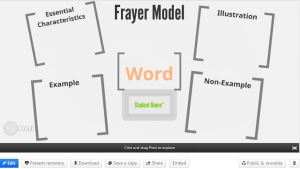
Click the images to be taken to the Prezi templates you can reuse in your own classroom.

Prezi Frayer Template

Prezi Template for Frayer Model

This version uses a picture as one element of the Frayer.
Frayer Picture Prezi

Prezi Template for Frayer with Picture

We have found that the strength of the Frayer model lies in its requirement that students explore “non examples” of the target term.  The Frayer is a simple graphic organizer with four quadrants and the word in the middle. It is similar to word maps and other vocabulary learning organizers. However, the Frayer asks students to dig more deeply into what they know and can discover about the term by examining critical attributes.  This is where non-examples come in to play.

A non-example must be more than just an opposite or something generic that a target word to be learned is not. That is to say, that if an astronomy target word is “eclipse” then the non-example cannot simply be “galaxy.” The two terms share a topic in common, but they do not share some attributes that lead to great depth of understanding. As students become increasingly familiar with the target word, they should also explore attributes of the term. Once they are familiar with the attributes of the target, they can identify non-examples that might be confused with the term because the non-examples might share some, but not all, of the target attributes.  Through discussion and exploration of internet resources, students come to a much deeper understanding of the concepts represented by the target word.

Using “eclipse” as a target word for Frayer, students might realize that the attributes of the concept of eclipse include one celestial body, such as a moon, passing in front of another, such as the Earth blocking light from reaching an observer. While celestial bodies pass in front of each other regularly, the key attribute of an eclipse is that light is blocked from the point of view of an observer.  A non-example of “eclipse” is “lunar orbit.” In a lunar orbit, the moon routinely passes in front of an observer on Earth, but only periodically does it also block the light from the sun.

In our work with vocabulary, we have found (see our article on Vocabulary Self-collection Strategy in The Reading Teacher) that a search for relevant images is a powerful way for students to make sense of the words they encounter. For this reason, we have changed one quadrant of the Prezi’d Frayer to include an image representing the target word. Finally, we suggest that students post links to their Frayer organizers on a class blog or other website.  Activities asking students to view and respond to each other’s Prezi’s further improve the possibility that students deeply learn the target words that are so important in many content areas.

We have made the two Prezi templates public and reusable. You can share these with your students to save as one of their own, or you can redesign our templates for your class needs.

Predictive Search

Have you ever been at the end of your rope and didn’t know what to write? Have your students ever felt like that? Read my post on the new International Literacy Association’s Literacy Daily blog to find out how to use this powerful tool to inspire writing might work.

Discipline-specific and Technical Dictionaries Online

By Thomas DeVere Wolsey 

One effective way of learning vocabulary specific to any given discipline is to use technical and discipline-specific reference sources. This list is not comprehensive, and anyone with suggestions to build this directory is encouraged to email me at info@iaieus.com or post a comment, below. Experts and practitioners use reference works that are specific to their fields all the time. What better way to help ease students into the world of your discipline than to guide them to the reference works that are specific to each field?

My criteria for inclusion in this list:

  • Resource must be fully accessible online.
  • Resource must be suitable (but perhaps challenging) for students in grades 6 through 12 and undergraduate (but not excluding those who are learning about the topic).
  • There is a reasonable probability that the resource will remain online for some time to come.
  • The resource presents accurate information that represents the field.

Art:

MOMA: http://www.moma.org/learn/moma_learning/glossary Search by artist, by theme, or alphabetically.

Business:

Inc.com Encyclopedia: http://www.inc.com/encyclopedia/ Search many entries relevant to business and entrepreneurism.

Web Copywriting Glossary: http://www.wealthywebwriter.com/web-copywriting-glossary/ Suggested by Benedict Paul (thanks!). I have included this in the business category, but it has some very good entries on writing (as you might expect) and technology, as well. (added 8/6/2015)

Literature:

Literature Dictionary: http://www.literature-dictionary.org/ Includes dictionaries of characters, dictionaries by author, and dictionaries of terms.

Mathematics:

Illustrated mathematics dictionary: http://www.mathsisfun.com/definitions/index.html. Easy navigation, intended for grades K-12.

Mathwords: http://www.mathwords.com/ Focuses on precision and readability. The site includes graphics to bolster the definitions.

Wolfram MathWorld: http://mathworld.wolfram.com/  Perhaps one of the most comprehensive resources for mathematics definitions on the web.

Encyclopedia of Mathematics: http://www.encyclopediaofmath.org/index.php/Main_Page An open-access resource with more than 8000 entries.

Music:

Naxos.com: http://www.naxos.com/education/glossary.asp Search alphabetically.

Physical Education:

Sports Definitions: http://www.sportsdefinitions.com/ Searchable by type of sport or alphabetically.

Science:

The Science Dictionary: https://www.thesciencedictionary.com/ This is actually a search tool that aggregates search results specific to science.

Enchanted Learning: http://www.enchantedlearning.com/science/dictionary/ Links to several specialty dictionaries by Enchanted Learning for students (e.g., botany, dinosaurs, land forms).

Geology Dictionary: http://geology.com/geology-dictionary.shtml Also, check out the map collections: http://geology.com/state-map/

Social Studies:

Ancient History Encyclopedia: http://www.ancient.eu/index/ Search alphabetically, by timeline, for images, or for videos.

Online Dictionary of the Social Sciences: http://bitbucket.icaap.org/ A comprehensive dictionary, designed for undergraduates, by Athabasca University.

Catholic Online: http://www.catholic.org/ So many figures and ideas are associated with the Roman Catholic church that a reference work may be very helpful. This one is supported by ads that can be annoying.

Taegan Goddard’s Political Dictionary: http://politicaldictionary.com/

Geography Dictionary & Glossary: http://www.itseducation.asia/geography/

Compilation of Architecture Dictionaries by Robert Beard: http://www.alphadictionary.com/directory/Specialty_Dictionaries/Architecture/ (Be sure to check out http://www.alphadictionary.com/specialty.html for many more specialty dictionary links. Some are better than others, but it’s quite a collection).

Technology:

NetLingo: http://www.netlingo.com/ One of the first and best (in my opinion) dictionaries for those interested in technology and internet-related terms.

~~~

Find more resources for literacy in the disciplines right here on Literacy Beat.