Delivering Presentations as Learning Opportunities

By Thomas DeVere Wolsey

We all know what a presentation is, right? The teacher presents information, typically thought of as a lecture, to a classroom full of students. A financial officer presents a budget to the board of a corporation. Students, having completed research on a topic present it to their peers. Often visual aids, such as a poster or PowerPoint enhance what the presenter has to say. Multimedia software, along with media hosting sites (e.g., YouTube) gives teachers and their students so many more options than a person with a laser pointer at the front of a room with a captive student audience. Equally important, those same multimedia tools offer the possibility of improving the learning they are intended to promote.

Presentations involve multiple steps; we can think of them as compositions. They require selection of a topic, identification of appropriate sources of information, characterizing that information for the audience, organizing it, choosing the presentation tools, designing the components of the presentation, rehearsing, and finally delivering it to the audience. Delivery is our focus for this blog post. Students are very familiar with traditional presentations using presentation software (e.g., PowerPoint, Keynote). In this format, the student (or a small group of students) prepare a presentation then deliver it to the class as a kind of lecture. Students do need to learn effective presentation skills in a face-to-face environment.

An effective alternative is to ask students to put their presentations online. Some presentation tools live online naturally. Prezi is one such tool, and Glogs make excellent e-posters. Newer versions of PowerPoint easily support audio files and can be converted to videos that may be uploaded to YouTube, Vimeo, and similar services. The big advantage is that students need not sit through all the presentations of their classmates. If the teacher embeds the presentation on a class blog or provides a link in a threaded discussion group, students may then select three or four presentations from their classmates to view. Other social media may also be used–Facebook, Edmodo, Twitter, etc. Using the comment feature of the blog or the threaded discussion forum, they comment on the presentations, adding to the information, questioning it, or suggesting strengths or possible alternatives to the ideas presented.


This format also works well for “dress rehearsal.” A student-created presentation might be shared via a private link to a small group for comment with an eye toward improvement of the product. Andrea Shea (Lapp, Wolsey, & Shea, 2012) taught her second graders to offer “praises” and “pushes” on student writing, and the idea can be used to help students improve their presentations, as well. A push is just gentle feedback designed to offer suggestions, alternatives, and the perspective of a member of the audience. As with written work, students often think of their presentation tools in a once and done way. They may not rehearse what they will say (either recorded or for live presentation) and design elements often benefit from feedback from an audience. Consider PowerPoint presentations with so much text crowded on the slide that the small text is almost impossible to read, or the slide with fonts so fancy they require much work of the audience just to get past all the curlicues and serifs (cf., Reynolds, 2010). Such presentation aids could benefit from some peer response during drafting.
High school teacher Jason Kintner promotes peer feedback on presentations through an Oscar or People’s Choice award format. He writes,

“Something I like to do in my classes to allow students to recognize and reward outstanding performance of the peers in delivering presentation is to designate specific awards. Students pick the top three presentations in the following categories (They are not allowed to pick the same student for each category):
• Einstein Award—Outstanding originality and depth of understanding.
• Rembrandt Award—Outstanding creativity and artistic ability.
• Gestalt Award—Presentation creates an “aha” moment, sudden burst of understanding, enlightenment, or enrichment.

References

Lapp, D., Wolsey, T. D., & Shea, A. (2012). “Blogging helps your ideas come out”—Remixing writing instruction + digital literacy=audience awareness. The California Reader, 46(1), 14-20.

Reynolds, G. (2010). Presentation zen design. Berkeley, CA: New Riders.

What Do Instructional Natives Need to Know about Technology?

By Thomas DeVere Wolsey

Students seem to know how to do all kinds of things digitally. They can tweet and text. Email is so last decade. iPads and Samsung Galaxy Tabs offer so many ways to connect to friends, family and the world at large via the Internet. Anyone can sign up for a MOOC. Fifteen-year-olds are outlining educational approaches—on a Washington Post blog, no less. Education professionals might be wondering just where they fit in the world where information is readily available.

Just what can teachers and other education professionals do when digital environments make data and information* seemingly ubiquitous? What is their role, if there is one? Last week, the National Council of Teachers of English updated its policy statement titled The NCTE Framework for 21st Century Curriculum and Assessment. What is notable about it is what is does not contain. There are no references to tools such as blogs or wikis. The word “computer” appears only once, and then only in the appendix. There is not a single reference to a SMARTboard or similar technology.

Rather, what is notable about this Framework is that is focuses on the dispositions of “Active, successful participants in this 21st century global society” (para 3). Verbs that characterize these 21st century outcomes include: design, create, develop, and manage. These verbs lend vibrancy to the technology and media students do and will continue to encounter even as the tools themselves continue to evolve (cf. Leu, Kinzer, Coiro, & Cammack, 2004). One aspect of the Framework is one that has long fascinated me; though the Internet can bring volumes of information right to the desk of anyone with access, the real strength of the internet lies in how it brings people together in new ways across and within cultures, affinity groups, geographical regions, and more. The Framework emphasizes this aspect, too.

Build intentional cross-cultural connections and relationships with others so to pose and solve problems collaboratively and strengthen independent thought.

This week, Project Tomorrow and BlackBoard, Inc. via the Speak Up National Research Project released a study exploring how those who want to be teachers are employing technology in their quest to become teachers and in their daily lives. The report also explores what aspiring or preservice teachers expect to encounter once they become teachers. The report delves into many nuances; however, here it is worth noting that though aspiring teachers use technology more than current teachers, they need and want models of how those technologies can be used in service of learning. Moreover, the principals for whom they might someday work hold high expectations that the new teachers entering the profession will be able to employ digital technology in service of learning.

The Project Tomorrow report continues to emphasize the problematic “digital native” metaphor (see last week’s post, for example); however, it does provide guidance for teachers who work with aspiring teachers including cooperating teachers in schools and teacher educators. Education professionals, as instructional natives, can help meet the needs of aspiring teachers and the demands of the 21st century, now well into its second decade. It is not necessary, or even realistic, to believe that any teacher, student, or teacher educator can “keep up” with every development on the technological horizon.

Some dispositions characterize instructional natives (Wolsey & Grisham, 2011) that may help:

• Teachers and teacher educators can use technology to assist them to better their own professional knowledge and connect with other educators.

• Teachers and teacher educators may not know how to use every tool available (and the secret is that neither do their students), but they can find online resources and ask their own students for help. Seeking the advice of students seems counterintuitive, at first, but I assert that this one quality is the hallmark of the 21st century instructional native.

• Teachers and teacher educators can trust their students to use media in responsible ways, with thoughtful guidance and questions from their teachers who are instructional natives.

• Teachers and teacher educators can and should regularly try out new technologies even if doing so is not quite comfortable at first.

References

Leu, D. J., Kinzer, C. K, Coiro, J. L., & Cammack, D. W. (2004). Toward a theory of new literacies emerging from the Internet and other information and communication technologies. In R. B. Ruddell & N. Unrau (Eds.), Theoretical models and processes of reading (5th ed., pp. 1580-1613). Newark, DE: International Reading Association.

Wolsey, T. D. & Grisham, D. L. (2011). A nation of digital immigrants: Four principles [online editorial]. The California Reader Online, 44(2), 1-9. Retrieved from http://tdwolsey.files.wordpress.com/2012/08/vol44no2_digitalimmigrants_11-05-10.pdf

* For an interesting discussion of the difference between data, information, knowledge, and wisdom, read:
Stewart, T. (1997). Intellectual capital: The new wealth of organizations. New York: Doubleday.

Four Online Reading Tasks

By Thomas DeVere Wolsey

Researchers are delving deeper into the nature of online reading tasks for PK-12 students; however, four common tasks emerge that readers encounter often. The MNOP teaching strategies (model, name, overcome obstacles, and probe) for digital and online texts are bolded throughout. Tasks readers might encounter in digital environments include:

  • Finding and reading appropriate material
  • Determining the best approach for reading digital materials
  • Synthesizing multiple sources
  • Integrating multimodal resources

Finding and Reading Appropriate Material

Confronted by search results from Google or other providers, readers must make a number of decisions. As important, they must do so quickly if they are to succeed in reading anything meaningful in a reasonable time frame.  Identifying appropriate online material is not as easy as it sounds; it involves much more than simply choosing some search terms.  Effective readers of online content try search terms, survey the results, refine search terms as necessary, skim some pages, and read other pages in depth.  Equally important: This process continues as readers encounter ideas and links to other sources; in short, the process does not proceed step-by-step.

Effective practice: Teachers assist readers to set a purpose for reading online sources, evaluate the sources they find, and challenge themselves to read increasingly complex materials online. They model these behaviors, often using a data projector or interactive whiteboard.

Example: Stephanie, a fourth-grade student, looked for information about “California missions,” but most of what she found using just those two words in her search was very broad, and repeated the same information.  She had visited the mission at San Luis Rey, and she knew it was not far from the famous San Juan Capistrano mission. Many of the sites in her search results included information about nearby hotels and restaurants which she knew would not help her learn more about the network of missions along the California coastline.  She knew she needed a web source that went into more detail than what she was finding, and she was sure the information was online somewhere. But, where was it?

CapistranoMrs. Wilkinson, the fourth-grade teacher, had seen students struggle with finding just the right search terms. She had learned that students often got stuck and couldn’t get out  of the mire of many search results but little useful information.  On her class webpage, she had linked some fourth-grade friendly resources.  When she saw Stephanie’s face scrunch up after another click to another website that wasn’t helpful, she walked over and watched for a minute.

“It looks like you have found several sites about the missions, and a couple of them about San Luis Rey that we visited last week on our field trip. But, you seem puzzled, too. What’s going on?”

Stephanie took her finger off the touchscreen, relieved somewhat for a chance to tell Mrs. Wilkinson about her search, “I found a ton of sites, but most don’t tell me anything new. I’m not sure what to do to find out more.”

“Ah, it’s no fun to search and search and come up with so little. That happens to me, too. I remember when we were at the mission, you wondered why San Luis Rey was built so close to the ones in San Diego and Capistrano. Is that what you’re trying to find out?” Mrs. Wilkinson probed.

“Uh huh. I thought it wouldn’t take long to find out. What do I do?”

Do you remember the class webpage we created with ideas to use when we get stuck? Why don’t you open a new browser window, so you don’t lose your place, and take a look at that link? It might have a model you can use.

Young readers of paper-based texts are frequently taught for finding texts that are not too hard to read, called the five finger rule, [learn more about the five-finger rule]. The five-finger rule is used to roughly determine how difficult a text will be; however, online, the five finger rule may not be very effective because page lengths are indeterminate, the amount of text on a page may be lengthy or very brief, and multimodal sources may also constitute portions of the information the reader is asked to process.  Instead, young readers can be taught to challenge themselves by asking themselves a few simple questions when they arrive at a website or other digital text:

  1. How well does it seem this information match my purpose for reading?
  2. How much do I already know about what I am seeing on the page?
  3. Do most of the words look familiar? If not, are there links to definitions or examples that can help me?
  4. Are there tools, such as Twurdy [learn more about Twurdy on this blog here and here], that can assist me in knowing how difficult this page will be to read?
  5. When I read this page, do I feel like I am challenged to learn new information as I read, or do I just feel overwhelmed?

Determining the Best Approach for Reading Digital Materials

Reading for specific purposes that promote content learning as well as increasing proficiency with text means that readers in digital environments must attend to features that differ from traditional paper-based texts. Readers must understand the fundamental differences of reading electronic texts from those in the paper-based environment, and they must be able to regulate comprehension processes in ways that recognize these differences.

Some differences are evident in the layouts designed to work well on a computer monitor or screen versus those that are designed for paper-based environments. A quick experiment will highlight the differences between what our eyes do as we read, what we must do with our hands and fingers, and what are brains are doing when we read complex texts.  Compare this blog post designed with the computer screen in mind with this PDF file that was originally designed mainly for paper (click the link for an example of such a text). As you read, what do you have to do when you read the bottom of page 23 with your eyes, your hands and fingers, and your thinking processes? What if you want to review something from earlier in the article? How do you locate it? Does that process interrupt the flow of your thoughts?

Reading many online materials means that young readers will bring to bear their knowledge of the topic, but it also means they must adapt to online text structures. Online text often differs markedly from paper-based text.  There may be fewer meaning cues to guide inferences because the author believes that the reader will click those links that are relevant to the reader.  The reading may proceed in a non-linear way that is quite unlike reading a book or article in a paper-based magazine.  It is up to the reader in exponentially different ways to construct meaning because the texts are interlinked. Readers literally go to additional sources rather than taking the author at face value, and the quality of inferences drawn may be much more complex. For readers, the potential of consulting a great variety of sources may result in richer thinking. The reader might, for example, consult the links provided by the author, or the reader may search for more information by initiating an original search.

Self-regulation of reading is foregrounded in most online reading environments.  In most reading situations, readers must ask themselves questions as they read and apply fix-up strategies when they realize that the words they read are not matching closely with the background knowledge they bring to the reading task (Hacker, 2004).

Moreover, online readers may be apt to distractions caused by advertisements, instant messaging, a great many sources in a search result and so on.  Teachers can assist students to avoid information overload by attending to the purpose for reading established early on and knowing when to switch from one reading approach to another.

The f-shaped pattern described earlier on this blog can be an efficient approach to locating appropriate sources online; however, as online readers find internet sources that are most helpful to them (focusing on the purpose for reading!), they should be taught to switch from scanning material to reading closely.

Close reading is a term readers will hear more often as the Common Core State Standards (2010) are implemented in most of the United States in the coming months and years.  A useful definition of what close reading is can help here:

Close reading: Close reading is characterized by the use of evidence from the text to support, analysis, conclusions, or views of texts. For example, responses to the definition of text complexity would begin with a reference to the place in the text where the term is defined (Wolsey, Grisham, & Hiebert, 2012, p. 2).

Effective practice: Readers of online materials may apply the same scanning approach to most, if not all, of the web sources they encounter, but sometimes they must slow down and read more carefully.  Teachers can help readers overcome obstacles when they encounter web sources that seem to require close reading. Web sources demand that readers determine when to scan search results and the webpages they find and slow down, applying more thorough approaches as they narrow their search to the information needed to meet reading purposes.

Example: Joe worked on his California missions project, and he was really excited to find out that the hero Zorro, had visited the mission at San Juan Capistrano.  When Mrs.  Wilkinson noticed his finding, she probed for more information. “That’s an interesting bit of information, Joe. Where did you learn this?”

Joe quickly pulled up the webpage, and pointed out that there was a neat picture of Zorro on the Capistrano mission’s website, and the  opening line talked about Zorro at the mission.  Mrs. Wilkinson knew right away that Joe needed help overcoming an obstacle—he had read too fast and not enough.  She probed some more, “Very interesting site, Joe. Zorro is one of my favorite characters, too. What else do you think you might learn if you read some more on this page?” (Note to Literacy Beat readers: There was an exhibit at the Capistrano mission about Zorro, a fictional character, and that is the webpage Joe had mistaken as fact about Zorro visiting the historic mission).

Synthesizing Multiple Sources

Our research, built on the theoretical work of Rand Spiro and his colleagues (e.g., 1992, 1996, 2004), leads us to believe that learners who must reconcile a variety of sources and support their own conclusions with evidence are more likely to think deeply and engage thoroughly with content at every level. Reading online, when properly scaffolded, can lead student readers to develop thinking by carefully evaluating the content they find online, choosing the sources most appropriate to their purposes for reading, and challenging themselves to approach complex material.

Effective practice: Teachers can assist students to approach many sources, evaluate those sources, note differences between them, and reconcile those differences by noting them and deriving their own conclusions. Probing students’ choices of sources and the manner in which they approach the reading task provides the teacher with the opportunity simultaneously name the process (skimming, close reading, and so) and model alternative practices based on the prior knowledge the teacher brings to the interchange as well as the prior knowledge the student has about the topic and the processes necessary for successful online reading.

Example: When Mrs. Wilkinson’s fourth-grade students began to explore the legacy of the California missions, they often encountered information that was new to them. For every new idea they included in their final multimedia projects, she asked students to do two things: 1. Determine the reliability of the source, and 2. Find at least two sources of information (three is better) that supported the new information.  She found that as students read to verify what they included in their projects, they also drew connections between the sources, noticed new ideas and information to explore, and found disparities between the sources for which they had to account.  As a result, they had a richer understanding of the role of the missions in California and that not all views of the mission were positive.

Integrating Multimodal Resources

Though textbooks and other sources have long included photographs, graphs, and artwork, online reading more thoroughly integrates media into the online reading experience.  Graphics are easier for authors to create in the 21st century and include as are video and audio elements.  Icons require readers of online content to understand the icon and the process clicking it may initiate. Often, icons provide support, such as pronouncing a word or reading a passage aloud, that a paper-based text cannot.  Increasingly, multimodal sources invite the reader to interact with concepts about which they have been reading (learn more on this blog about multimodal learning).

Effective practice: Students are often innately aware that multimodal elements found in online reading are worthy of their attention or may be a distraction depending on the purpose for reading the online text, the arrangement of elements on the page, and the relevance of those multimedia elements to the text (and the other way around).  However, novice readers may be distracted by these or lack a process for reading text and viewing multimodal elements.

Example: Often, as Mrs. Wilkinson’s fourth graders worked with online sources, they found video clips, photographs, and primary source documents from the era linked or embedded within the text.  She taught them to decide what elements seemed to be more useful by watching short bits of video to determine whether to watch the entire piece.  Students learned to quickly scroll through a webpage noting the types of information in addition to the words, and whether any of those were ads and other visual information that might not be relevant at all.

Reading Online Text

What difficulties and successes have you and your students encountered when reading digital texts? What made the reading a friendly experience? How have you and your students challenged yourselves to read increasingly complex texts, perhaps a little beyond your comfort zones?

References

Common Core State Standards. (2010). Common core state standards for English/language arts and literacy in history/social studies, science, and technical subjects. Retrieved from http://www.corestandards.org/assets/CCSSI_ELA%20Standards.pdf

Coiro, J., & Dobler, E. (2007). Exploring the online reading comprehension strategies used by sixth-grade skilled readers to search for and locate information on the Internet. Reading Research Quarterly, 42(2), 214-257.

Hacker, D. (2004) .Self-regulated comprehension during normal reading. In R.B. Ruddell, & N. Unrau (Eds.), Theoretical models and processes of reading (5th ed., pp. 755-779). Newark, DE: International Reading Association

Spiro, R. (2004). Principled pluralism for adaptive flexibility in teaching and learning to read. In R. B. Ruddell & N. Unrau (Eds.), Theoretical models and processes of reading (5th ed., pp. 654-659). Newark, DE: International Reading Association.

Spiro, R. J., Feltovich, P. J., & Coulson, R. L. (1996). Two epistemic world-views: Prefigurative schemas and learning in complex domains. Applied Cognitive Psychology, 10, 51-61.

Spiro, R.J., Feltovich, P.J., Jacobson, M.J., & Coulson, R.L. (1992). Cognitive flexibility, constructivism and hypertext: Random access instruction for advanced knowledge acquisition in ill-structured domains. In T. Duffy & D. Jonassen (Eds.), Constructivism and the technology of instruction (pp. 5-75). Hillsdale, NJ: Erlbaum.

Wolsey, T. D., Grisham, D. L., & Hiebert, E. H. (2012). Module 1: Participant edition – What is text complexity? TextProject Teacher Development Series. Retrieved from http://textproject.org/teachers/teacher-development-series/

Reading Complex Texts In Digital Environments: Four Teaching Practices

By Thomas DeVere Wolsey

Go to the parking lot of almost any school and ask ten adults (parents, school staff, faculty, etc.) if technology is helping students to be better readers in general or if it is detrimental to student reading.  While you will have ten very different answers, it is very likely that most of those adults will tell you that digital technology hinders students’ reading capacities.  This need not be the case, however.

Fortunately, teachers hold the answer to improving how their students interact with digital texts. Many have anticipated that asking students to read complex texts also mean asking them to navigate digital environments more often. In this post, we explore effective practices to help students navigate complex digital environments and the texts found there.

As schools move toward increasing the amount and the complexity of texts students read, digital environments will become increasingly important in meeting the goals to prepare students for college and work (CCSS, 2010). Reading online differs in many ways depending on the text itself and the electronic format (e.g., Kindle or Nook, PDF or HTML webpage, etc.). Here are four effective practices for teachers to encourage engagement with complex digital texts. In a future post,  I will explore those four practices in context of four reading tasks students might confront when reading digital texts.

MNOP

Model, Name, Overcome obstacles, Probe

Teachers can do a great many things to help students find, engage, and comprehend complex materials in digital environments.  Four critical teacher practices include modeling, naming, overcoming obstacles, and probing.

M (source: http://www.clker.com/profile-160226.html) Modeling may be the most time-honored tradition of the effective teacher, with good reason, we add.  When students see their teachers or peers employ effective reading habits, they tend to mimic those habits. Moreover, as they do so, they expand their repertoires of skills that serve them when they encounter new or challenging texts.

N (source: http://www.clker.com/profile-160226.html) Naming recognizes that students have skills on which they draw. However, students don’t always know why a skill or strategy might work effectively or under what conditions. When a teacher names the strategy, the student learns that it is an effective approach recognized by others and that it can be replicated.  For example, Howard is a sixth grader who skimmed several search results finding one near the bottom of the page that met his purpose for searching and reading.  His teacher noticed what he had done and specifically named the strategy as “skimming for the best website.”

O (source: http://www.clker.com/profile-160226.html) Overcoming obstacles suggests that novice readers of digital content often arrive in class with preconceived notions of what reading online is all about.  Sometimes those ideas are accurate, but at other times, these ideas present obstacles to comprehension of digital content.  For example, readers of webpages typically use a skimming strategy that resembles the shape of an ‘F.’ They read the top line, skim the left margin, and occasionally read a portion of a line partially down the page.  The strategy is effective when readers try to determine if a site is worthwhile for their purposes; however, it may hinder reading of complex content if the same skimming strategy is employed.

Read more about the F-shaped pattern on this blog: https://literacybeat.com/2012/08/28/text-complexity-digital-reading/

P (source http://www.clker.com/profile-160226.html)Probing involves teachers watching their students read online and probing for insights into their thinking processes as they read. For example, Sheila’s tenth-grade social studies teacher noticed that she selected a link with challenging vocabulary about a Civil War battle site instead of an easier site intended for younger readers.  He asked her why she chose the site, and she explained that the easier site presented information she already knew; she wanted to challenge herself.

Next month, we explore how these four teacher practices can be applied as students work with complex digital texts.

  1. Find and read materials that meet academic and other purposes
  2. Determine the best approach for reading digital material
  3. Synthesize multiple sources to create a deeper understanding
  4. Integrate multimodal resources into their reading experiences

Reference

Common Core State Standards Initiative. (2010). Common core state standards for English/language arts and literacy in history/social studies, science, and technical subjects. Retrieved from http://www.corestandards.org/assets/CCSSI_ELA%20Standards.pdf

Images source

abaverman. (2012). Letters M, N, O, and P. Retrieved from http://www.clker.com [creative commons CC0 public domain dedication]

Text Complexity in the Digital Age: An F for Online Reading?

By Thomas DeVere Wolsey

If you are reading this, chances are good that you are a teacher or education professional. As a result, the subtitle probably caught your attention right away; but this blog post is not about the ill effects of digital reading. Instead, we are going to explore what reading online might mean at a time when we will all be searching for ways to increase the amount and quality of text students read and the complexity of those texts. Shortly, you will see why an F in digital reading can be a useful tool.

Why Do Digital Texts Get an F?

To understand how text complexity can be promoted in the online environment, it helps to know and understand how readers approach reading many webpages. As you probably know, readers’ eyes move across text sweeping from left to right (a saccade) and stopping on some words to take in the content and perhaps focus on more challenging terms or phrases (fixations). However, when readers go online to a search engine, their reading tends to skip wide swaths of text as they search for the content they need. Eye movements can be tracked, and during perusal of a search result, the places where the reader’s gaze tends to be most concentrated resembles an ‘F’ shape. It would not be productive to read every word of a search result. Rather, the reader takes in key terms most often on the left side of the screen and sweeps across in some places forming the arms of the ‘F.’ Would you like to see what eye movement tracking of a search result might look like? Check this out:

An image from Clickrmedia: Eye Movements on a Search Page

More important, once readers do select a web source to read, they tend to follow the same pattern during initial reading of the webpage. Because reading on the screen is somewhat different than reading on paper, web designers actually take advantage of this F-shaped pattern and write text using headings and key words that fall within the F-zone in an effort to gain the reader’s attention. This results in important concepts from the site being conveyed to the F-zone reader, and perhaps entices the reader to go beyond the F-zone and read more closely. This is a good thing for the same reasons we cannot and should not read every word on a search page. The challenge for teachers and the readers in their classes is deciding when to use this strategy and when to go beyond this approach and read a bit more thoroughly and perhaps slowly. In this photo, you can see what the F-shape looks like when eye movements are tracked. The redder the color, the more time the reader spends looking at the content on that part of the page.

An image from the Nielsen Norman Group: Eye Movements on Three Webpages (Notice the general shape of the ‘F’)

F-shaped Pattern

See eyetracking in action (real-time): http://www.vimeo.com/40021154 (source: The Nielsen Norman Group)

…and eyetracking in action (slowed-motion version):  http://vimeo.com/40021215 (source: The Nielsen Norman Group)

Is F-Shaped Reading a Problem?

Some voices in education believe this F-shape reading pattern is part of a larger problem that demonstrates how online reading in some way detracts from a reader’s ability to comprehend complex and longer texts. While we certainly need more research in the area of digital reading and how it affects young readers (and older ones, too), we can use what we know about the F-shaped pattern to our advantage in the classroom. Slow and careful reading need not be impossible in digital environments.

Effective reading online involves complex skills that can build what Newkirk (2012) calls a growth mind-set. This mind-set “…is the capacity to view difficulty as an opportunity to stop, reassess and employ strategies for making sense of problems” (p. 122). When readers encounter uncertainty, they may quickly navigate away from the webpage causing doubt; however, teachers can assist readers to make clear and conscious choices to seek out uncertainty, confront doubt, and consult many sources. Moreover, maintaining a healthy skepticism that promotes further inquiry even as some uncertainty is reduced, new doubts will surface. A  reason the Common Core State Standards Initiative (2010) includes qualitative elements represents recognition that young readers and their teachers have a role in deciding how they may challenge themselves to greater growth as proficient readers.

A really neat thing about the human brain is that it is very capable of changing its own behavior. Metacognition theories tell us that thinkers (in this case, thinking through reading) can be aware of their learning behaviors and consciously choose to adapt them to suit varying purposes and contexts. Because the Internet is full of worthwhile and complex texts, the online environment presents a challenge for young readers. Fortunately, the challenge is one educators are well-equipped to take on. Reading online has many facets, and four of them appear in the list below. In this post, we have zoomed in on reading habits in online environments. Others will be explored in subsequent posts.

  1. Finding the most appropriate reading material
  2. Determining the best approach for reading that material
    1. Monitoring reading habits
    2. Reading text in a non-linear manner (cf. Reinking, 1997)
  3. Synthesizing multiple sources
  4. Integrating multimodal resources

A Challenge to Readers of Literacy Beat

As you read the remainder of this post, here are some reader challenges for you. Did you use the F-shaped pattern in selecting this blog post from a search engine? Did you use the F-shaped pattern as you read the post at first (remember, this is a good thing)? Did you read “below the fold” or the point at which you had to scroll to get at more content? At what point did you decide to abandon the F-shaped pattern and choose a different approach (you did, didn’t you?). Why did you change your approach? Finally, if you are a teacher, how have you helped your young readers to understand and effectively read online sources?

Tools and thinking habits for evaluating the reliability of online sources are well-known (e.g., Schrock, 2002). Therefore, we won’t spend more time with these tools here. A good point to add, though, is that online readers often do not apply principles successfully for evaluating sources even if they know they should do so (e.g., Leu, Zawalinski, Castek, Banerjee, Housand, Liu, & O’Neil, 2007). Effective instruction in choosing reading material online that suits the purpose for the search and challenges the reader to think deeply about the topic of the search is critically important. To that, I should emphasize that students need to be taught how to select online reading that is appropriately challenging to them rather than defaulting to the easiest material available.

While the F-shaped pattern seems to be the default reading pattern for reading on the web, there are appropriate times when readers should slow down and read closely. In Module 1 on the TextProject site, we defined close reading in rather concise terms:

“Close reading is characterized by the use of evidence from the text to support analysis, conclusions, or views of texts. For example, responses to the definition of text complexity would begin with a reference to the place in the text where the term is defined” (Wolsey, Grisham, & Heibert, 2012, p. 2).

The F-shaped pattern and close reading of complex texts need not be exclusive of each other. There are times when scanning content is appropriate and other times when slowing down and reading closely is the better choice—even for web content.

Please use the comment feature of this blog to explore this topic with us.

  • How do you help your students choose increasingly complex texts that challenge them as readers to work with uncertainty?
  • In what ways do you help students monitor their reading behaviors such that they move from the F-shaped pattern of most web reading tasks to the slower close reading tasks associated with complex text?

References

Common Core State Standards Initiative (CCSS). (2010). Appendix A: Research supporting key elements of the standards; Glossary of key terms. In Common Core State Standards for English language arts & literacy in history/social studies, science, and technical subjects. Council of Chief State School Officers and the National Governors Association. Retrieved from http://www.corestandards.org/assets/Appendix_A.pdf

Leu, D. J., Zawilinski, L., Castek, J., Benerjee, M., Housand, B., Liu, Y. & O’Neil, M. (2007). What is new about the new literacies of online reading comprehension? Retrieved from http://www.newliteracies.uconn.edu/pub_files/What_is_new_about_new_literacies_of_online_reading.pdf

Moje, E., Overby, M., Tysvaer, N., & Morris, K. (2008). The complex world of adolescent literacy: Myths, motivations, and mysteries. Harvard Educational Review, 78(1), 107-154.

Newkirk, T. (2012). The art of slow reading. Heinemann: Portsmouth, NH.

Reinking, D. (1997). Me and my hypertext:) A multiple digression analysis of technology and literacy (sic). Retrieved from ReadingOnline: http://readingonline.org/articles/art_index.asp?HREF=/articles/hypertext/index.html

Schrock, K. (2002). On a good website you can tell… Retrieved from http://kathyschrock.net/abceval/primary/index.htm

Wolsey, T. D., Grisham, D. L., & Hiebert, E. H. (2012). What is text complexity? Teacher Development Series. Retrieved from http://textproject.org/tds

Transforming Writing Instruction in the Digital Age

a post from Bridget Dalton, Aug. 7, 2012
book cover of"Transforming Writing Instruction in the Digital Age"

Dana Grisham and Thomas DeVere Wolsey’s new book, “Transforming Writing Instruction in the Digital Age: Techniques for Grades 5-12”. is a wonderful resource for all of us who are striving to integrate technology and writing instruction in ways that make a meaningful difference for our students. I was honored to write the foreword for this outstanding volume and have provided it below for your information. I’ve been re-reading the book in preparation for the fall semester and was struck by its timeliness and relevance to the Common Core State Standards. This adds even more to its value!

The book is available at http://www.guilford.com/p/wolsey

From Transforming Writing Instruction in the Digital Age: Techniques for Grades 5-12 by Thomas DeVere Wolsey and Dana L. Grisham. Copyright 2012 by The Guilford Press. All rights reserved.

Foreword
My friend calls out, “The water’s amazing! Jump in!” I hesitate. “Hmmmnn, shall I? It looks cold. Are those clouds on the horizon? I like to swim, but snorkeling is relatively new to me.” I stand at the edge of the dock, watching my friend enjoy herself. I know she is an experienced snorkeler and this is one of her favorite spots. I grab hold of my gear and step off the edge. “Okay, here goes, I’m JUMPING! Wow, this feels great!” And away we go, my friend and I, swimming over the coral reef, ready for an adventure together.

Thomas DeVere Wolsey and Dana L. Grisham have written a book about technology and writing that invites us to “Jump in!” and join them in the adventure of integrating technology into the teaching and learning of the millennial generation. They invite us to jump (or step, if you are feeling a bit more cautious) into the exciting and sometimes turbulent waters of teaching writing in today’s schools. They guide us to focus on what’s important about writing, learning, and the role that technology and media can play in improving the quality of our students’ compositions, their use of writing to transform learning, and their engagement with academic literacy.

Leaders in the scholarship and practice of digital literacies, DeVere and Dana are expert guides who share the wealth of their knowledge and experience in this book, which is designed to help teachers take the next step forward in using technology to engage students in writing that is worth doing. The book artfully combines theory and practice, presenting numerous examples and vignettes to offer a vision of what is possible, along with the concrete suggestions and practical tips that are essential to success. I had barely started reading the manuscript and taking notes to prepare me for writing this foreword when I found myself opening a second document file to take note of teaching ideas, digital tools, and resources that I knew would be useful to me in my own work. The book had a larger effect on me, how- ever, stimulating my thinking about our underlying models of composition in a digital world and the urgent need to improve both theory and practice. It also reinvigorated me. The status quo is not working for too many of our students. It’s not working for many of us who are teachers. Using technology to help students create, communicate, connect, and learn is one way to change things. I believe that teachers, literacy coaches, teacher educators, and curriculum specialists will find this book to be a valuable resource, one that provides multiple entry points and pathways to follow in accordance with their individual goals, subject areas, and levels of technology expertise. In the following section, I highlight some of the key features of the book that I think make it a particularly valuable resource.

Student learning and writing pedagogy drive technology integration, not the other way around.
I love “cool tools.” In fact, my colleague Debbie Rowe and I lead a multimodal composition research group for doctoral students that begins each session with one of the members sharing a digital tool that has interesting implications for research and practice. DeVere and Dana offer a rich array of digital tools and resources throughout their book. However, it is abundantly clear from the Introduction through to the last page that their book is about writing, is about learning, and is about engagement. Technology and media are essential to making that happen. We need the nuts and bolts to build something, but we also need to have a vision for what we’re building, to understand why it’s important, and to know how we go about constructing it. Before we begin, we want some evidence that what we’re doing is supported by previous experience and success.

Dana and DeVere set their vision in the Introduction and then extend and apply it in each chapter. They draw on Bereiter and Scardamalia’s (1987) models of writing as either “knowledge telling” or “knowledge transformation.” While they acknowledge the role of “writing to tell,” their passion is in helping students use writing for knowledge transformation. I appreciate the way they structure each chapter to open with sections on “What is it?” and “Why is it important?” before moving on to how technology can help. Theory and research are embedded throughout (and where the research is limited, they suggest practices that are promising). The continuing message is that technology is both medium and message, and that it is their particular use by knowledgeable teachers and their students that will move us forward.

Writing is not just for English; writing is discipline specific.
Often there is a divide between folks who love to teach writing for literary purposes and those who love to teach their content and view writing as a vehicle to communicate learning. DeVere and Dana offer a more integrative perspective. They make a strong case for why writing is part of academic literacy. Writing is not just a matter of genre and text structure; rather it’s a way of thinking and using language and symbol systems to communicate within our community. A real strength of this book is the range and depth of examples from English, social studies, and science classrooms that illustrate how technology and media can transform the learning process and offer new opportunities for students’ creative expression, social interaction, and learning. Students compose to grapple with challenging content and accomplish purposes specific to the subject matter. While composing tools might be considered somewhat generic, Dana and DeVere illustrate how it is what you do with them in relation to particular academic content and skills that can make all the difference between a “just okay” and an “amazing” student- learning experience and outcome.

We’re all in this together, or teachers and students are making it happen.
In public speeches about educational reform and in professional devel- opment efforts, we often hear that teachers are leaders and that our notion of “what works” should expand to include practitioners’ expertise and expe- rience. The democratization of publishing on the Internet has offered many teachers the opportunity to communicate directly with an audience that is interested in learning from and with them as they go about the daily work of teaching in schools. Blogs, websites, and wikis are just a few of their online venues. However, teachers’ voices are less well represented in published text- books. One of my favorite features in this book is the inclusion of in-depth classroom examples in each chapter. Some examples are written by teachers, whereas others are written by DeVere and Dana at a level of detail that shows their intimate knowledge of the teacher, his or her classroom, and students. It is the combination of Dana and DeVere’s expertise with the expertise of some amazing classroom teachers that give this book depth and credibility.

Affect matters—for students and for us.
Have you ever taken a course or a workshop because of the way the instructor teaches, as much as the content of the course? The importance of affect and the social basis of learning is just as true for adults as it is for children—perhaps even more so, since we bring firmly entrenched beliefs and dispositions along with vast stores of knowledge and skills to each learning encounter. Clearly, DeVere and Dana are highly expert and experienced in the field of writing and technology and there is much to be learned from the information in this book. They are somewhat unusual, I think, in the way that they have shared some of who they are through their writing of this book. Their writing style and tone are conversational as they think out loud, conjecture, joke, and share strong feelings and convictions. They respect teachers and children. They understand and have experienced the realities of real teaching, real kids, and the unpredictability and promise of teaching with technology. They are resilient and hopeful about the future of students in our schools and the role of technology and writing in making change happen. By the end of the book, I was very glad to have had Dana and DeVere’s guidance and to know that they are continuing their adventures in writing and technology. Jump in and try an adventure of your own—I know I will.

Bridget Dalton, Ed.D.
Vanderbilt University

Order Transforming Writing Instruction in the Digital Age: Teaching Practices That Work on Amazon.

What is Text Complexity: TextProject Resources

By Thomas DeVere Wolsey and Dana L. Grisham

Have you heard the term “text complexity” and wondered what it means for you and your students? Dana and I, along with Freddy Hiebert, have developed a series of teacher development modules that we want to share with you. These can be incorporated into professional development activities or course syllabi for graduate degrees and teacher education programs. The modules may also be used by individuals who just want to explore what text complexity will mean in their classrooms. Right now, a preview version of the first module is available online on the Teacher Development Series page of TextProject.  The full series of five modules will be available on August 16, 2012.  In the meantime, we hope you find this preview useful and informative.

Text Complexity

from the Common Core State Standards Initiative

More on text complexity on this blog: Follow the link.

Differentiation Meets Digital Technology

A Planning Process for Differentiated Instruction with Digital Tools

By Thomas DeVere Wolsey

Differentiating instruction is a time-tested way of thinking about meeting students’ needs as they make progress toward achievement or learning targets.  Differentiation is an elegant mindset that suggests to teachers a framework that permits them to engage students while focusing on learning results, and digital technologies offer many opportunities to differentiate instruction in meaningful ways.  However, differentiating instruction takes a concerted planning effort on our parts as teachers and teacher educators. This is especially so as we develop a mindset that differentiation can be effective. In this post, I propose a three-phase approach to planning differentiated instruction:

  1. Where do we start planning for differentiated instruction with technology?
  2. What are considerations for who we teach, what we teach, and how we plan?
  3. How do I put it all together?

Throughout this post, you will notice a pattern of threes based on where, what and who, and finally how. Because examples often help, this post will close with one which I hope will inspire you to even better differentiation with technology.

Where Do We Start the Planning Process?

  • Curriculum: What standards and lesson objectives are appropriate?
  • Results: What are the key attributes of the target concept to be learned? What is acceptable evidence that students are learning?
  • Resources: What human, digital, and traditional resources are available?

Let’s start with a premise: Planning differentiated instruction enhanced by technology is a perfect fit for the principles of understanding by design (Wiggins & McTighe, 2005) in which teachers plan instruction based on the results they intend for their students.  This means that before any digital tools are chosen, before a single activity is determined, before assessment instruments are designed, the intended results must be decided. Results are informed by standards and further refined by lesson objectives. They are carefully honed predictions for student learning that require the teacher to determine the key attributes of target concepts and consideration for what acceptable evidence of learning might be. Once we know we have this down, the rest falls into place.

Right now, you might be wondering, “Hey, where’s the technology?” At this point in our three-phase approach, we can ask ourselves what human, digital, and more traditional resources are available to support these learning events.  It will be tempting to think something like, “I really love Prezi and Glogster” so I’ll design my activity around those two tools.” An analogy might be helpful here as a kind of caution about choosing the technology before moving forward with other aspects of instruction.

In my backyard, I have decided to build a shed to store potting soil, extra pots, shovels, and so on. I know I have a claw hammer and a sledge hammer. I like my hammers, so I decide that those are the tools I will use.  Already, you can see this will not work out well. I may need other tools, and I may even have to borrow one from a neighbor or go to the hardware store and buy a tool for this task.  To be successful, I will need a pretty good inventory of the tools that are required for the job, the tools I own, and the tools I will borrow or buy. Planning to use technology to improve differentiated instruction is like that, too.  The technology should match the demands of the tasks.

What Do I Differentiate + Who and How?

  • Differentiate curriculum by process, product, or content
  • Based on readiness for learning relative to the standards and objectives, student interests relative to the standards and objectives, and the way they learn in general
  • While considering overall lesson design and time requirements

Once we have a firm grasp on what results we expect based on standards and objectives, we can begin to think about the best ways to challenge our students. Embedded in what we differentiate are considerations for who our students are and what we know about them along with what aspects of the curriculum might result (there is that word again) in effective student learning.  Curricular elements we can differentiate commonly include the processes of learning, the products of learning, and the content on which learning is based (Tomlinson, 2001).  Juxtaposed with those elements are the needs of the students including their readiness for learning relative to the standards and objectives, their interests relative to the standards and objectives, and the way they learn as a general rule. Learning needs and curricular elements or demands can be thought of as a matrix, as represented in figure 1. What cell on the matrix might produce the best learning results for the specific students sitting in the classroom? Finally, we need to decide what part of the lesson will be differentiated, how much time is available, and how this lesson fits in broader learning goals.

Differentiation Matrix

Figure 1: Differentiation Matrix

How Do I put it All Together?

  • Develop options and choices for learning
  • Based on identified learner needs relative to the standards and objectives
  • While keeping in mind key attributes of the target concept and intended learning results

Options: High-quality differentiation typically means different students doing different things that lead to achievement of a common learning goal.  Developing options is an effective way to put differentiation into effect. Sometimes the options are choices students can make based on the information they have about their own learning needs. At other times, the options are decisions that teachers make for students or are choices students make with guidance and nudging from their teachers. Options for learning in high-quality differentiation are always made with the key attributes of the target concept and effective learning results in mind.

Teachers develop options that meet identified learner needs while keeping key attributes of the target concepts and results in mind.

Checking for Differentiation: To check the effectiveness level of differentiated instructional tasks, fill in this sentence with details from your own lessons. Choose the element from the list in brackets or fill in your learning objectives or standards:

Based on what I know about the curriculum and my students, their [interests, readiness, or learning profiles] are [identify those interests, readiness levels, or learning profiles] relative to the objective of [insert the objective]. The [process, product, or content] will help students [achieve the objective] because…

So, Why Technology?

Early in this post, I asserted that technology offers the potential for powerful differentiation that results in high-quality learning. How digital technologies are embedded in the learning tasks is vitally important. They can be simple tinkering (or micro-differentiation, as Tomlinson, 2001, asserts) or those digital tools can vastly improve how students learn and how they interact in our digital world.  In choosing tools to be part of the options or choices available to students, three (remember our rule of threes for each phase?) questions can guide our thinking about what tools are appropriate and useful.

  • What tools do my students know or might they learn to use?
  • What digital technologies are available to the students in the classroom, at school, at home? And a corollary: What digital technologies can students bring with them to school to assist in their learning?
  • Will the digital technologies that are part of the options for students really improve their learning relative to standards, objectives, and intended learning results?

Another example of high-quality differentiation using technology is available in this video:

An Example from a High School English Classroom

Imagine a high school English course in which students are expected to understand and analyze characters in novels they selected as part of a coming of age unit.  The standard, drawn from the Common Core State Standards Initiative (CCSS, 2010) informs these differentiated tasks.

RL.9-10.3. Analyze how complex characters (e.g., those with multiple or conflicting motivations) develop over the course of a text, interact with other characters, and advance the plot or develop the theme.

The lesson objective relates directly to the CCSS standard; that is, students will be able to form inferences about characters from dialog and from their actions. Making inferences about characters from dialog and actions are key attributes that the teacher will use in guiding students as they work on differentiated tasks, and that will inform feedback she provides to students as they work.  In the following example tasks, notice how the tools enhance the learning rather than restrict it; at the same time students are encouraged to use new literacy skills in learning as they complete the tasks. In these examples, presented as directions to students, tasks are based on student choices, provide flexible grouping arrangements, and encourage a limited range of technologies that align with the intended learning result.

Differentiation of Product by Student Interests (based on the novels they selected to read):

1.  Sometimes what characters in novels we read say speaks volumes about them. Work with someone who read a book that is different than your own. Using Voicethread or a podcast, each partner should choose a character from their respective books. Create a dialog between those two characters that is clearly based on inferences you made about your respective characters. If you choose to work with Voicethread, choose appropriate images to correspond with the dialog you create. Ask yourselves, what would these two characters from different novels say to each other about their coming of age experiences? Challenge: Can you include, in your dialog, references to  characters’ actions that lead you to believe characters would respond in a certain way?

2.  Sometimes what characters in novels we read do tells us volumes about them. Work on your own to create a tree diagram, which includes several levels. If you would like to see an example of a tree diagram, click here. Use one of the interactive graphic organizer tools you find on the class webpage (for readers of this post, some possibilities are listed among the many tools here). At level one, identify the character and include the title of the novel. At level two, identify three or four characteristics of your chosen character that are based solely on their actions. At level three, find three or four actions in your novel that support your choice of attributes. Hint: You may want to choose the actions and categorize them, then identify the characteristics based on those attributes. Challenge 1: Share your graphic organizer with another member of your group and ask that person to add to your graphic organizer by either expanding the list of characteristics or adding to the possible actions that support the characteristics you chose. Challenge 2: Can you add a fourth level with an example from what characters say that supports the characteristics you chose?

3.  Sometimes what characters in novels we read do and say tells us volumes about them. Using the Twurdy search engine, find three reviews of your novel that include analysis of the characters in the novel you read.  Post your findings along with a paragraph indicating why you agree or disagree with the reviews you found. Be sure to include evidence in the form of inferences you have drawn from dialog or actions. Three to five examples will serve as evidence.  Work with a member of the class who read a different book than you did to determine if there are common attributes for the characters in the two different novels. Use Google Docs to create a matrix similar to the one you see here. Share your link on the class wiki. Challenge: Can you identify a character from your novel that is like any of the characters in our reading of a Shakespeare play (or other touchstone text) earlier this year?

In each example task, the students act on the interest in the novel they have read, and they create a product that is true to the standards and objectives.  Each can be assessed based on the intended results that are embedded in the standards, and each includes technology components that might increase student learning through collaborate to further enhance learning. Using the sentence frame suggested above, the teacher checks for differentiation:

Based on what I know about the curriculum and my students, their [interests ] are [grounded on the novels they selected to read for literature circles] relative to the objective of [character analysis]. The [product] will help students [analyze characters] because they must attend to the critical attributes of a character’s actions or interactions in dialog.

In your classroom, what successful tasks have you designed with the end in mind that were built on solid principles of differentiation and use of digital technologies? Use the comment button to add your thoughts to the conversation.

References

Common Core State Standards Initiative. (2010). Standard RL.9-10.3. Common Core State Standards for English language arts & literacy in history/social studies, science, and technical subjects. Council of Chief State School Officers and the National Governors Association. Retrieved from http://www.corestandards.org/the-standards/english-language-arts-standards/reading-literature-6-12/grade-9-10/

Tomlinson, C. A. (2001). How to differentiate instruction in mixed-ability classrooms, 2nd ed. Upper Saddle River, NJ: Pearson.

Tomlinson, C. (1999). Differentiated classroom: Responding to the needs of all learners: Alexandria, VA: ASCD.

Wiggins, G., & McTighe, J. (2005). Understanding by design (Expanded 2nd ed.). Alexandria, VA: Association for Supervision and Curriculum Development

Draw Me a Story; Write Me a Picture

By Thomas DeVere Wolsey

Pictures and words have gone together since the first word emerged from logograms in ancient Mesopotamia over 5000 years ago. One of the earliest illustrated books written specifically for children was Orbis Pictus (Comenius, 1658), and it took advantage of the power of pictures and words combined together. Today, graphic novels and comics are widely popular because, in part, they match words with images that, together, convey more than either might alone. Today, educators recognize the ability of properly chosen words matched with other visual information whenever they select a graphic organizer or teach students to create their own graphic organizers. In this Literacy Beat post, I explore how images can inspire young writers and how young writers might learn how their writing can inspire image-making, as well. Of course, in keeping with the theme of this blog, digital technologies will be central to our exploration.

Often, words accompany images (and vice versa) in such a way that one limits the other. For example, a caption under a photograph may limit the way the viewer of the photograph interprets the image. Charts, pictures, and graphs in an academic text may expand on some idea conveyed by words in the accompanying text. But, I wonder if the professor who taught a group of future teachers, me among them, was onto something when she noted that to really understand a thing, one had to draw it. Sometime later, a statistics professor encouraged a group of doctoral students that to understand statistics, one had to be able to draw the results. Images, these professors suggest, have the power to enlighten and inspire in ways words cannot. This may seem an odd thing for a person whose entire career is built around literacy education, so perhaps an example might help.

Write Me a Picture

As an entrée into poetry, I frequently asked middle school students to turn words into pictures. These concrete poems incorporate words in a physical arrangement that becomes an image. Michael P. Garofalo has created several that may serve as a model for your student writers, some of which make creative use of the online environment. Click the thumbnail to take a look at one.

Concrete Block

Michael P. Garofalo

Pencils and paper still work, too. Click the thumbnail to see a student-created example.

Mexican Mariachi

Mexican Mariachi by an 8th-grade Student

Putting words together with images is a first step in thinking about how images might improve writing. It is also a first step in teaching students about composing multimodal texts that make the best use of the combined media.

Draw Me a Story

Images that inspire writing  can be used insructionally in many ways.  Three of those explored here are student-created images, prompts writing with images, and combined text and images via the infographic.

Student-created images can inspire students to better understand the world through their writing. One science teacher I know asked students to go outside and draw an outline of the landscape and buildings around their homes. Then every hour for four hours in a row, they were to go outside and draw in the moon as it appeared to them relative to the skyline. The images were simple, mainly outlines, but the learning the drawing activity inspired led students to notice something about the very familiar moon that they had never noticed before. These drawing led to inquiry about the motion of the Earth and its moon, and the inquiry with the pictures led to writing that was sometimes filled with the wonder that much school-sponsored report writing often lacks. Others have also asked students to observe natural phenomena closely through drawing and writing field notes in the form of a journal: If you would like to read more about the moon project, click here.

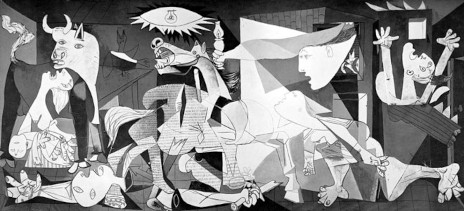
Prompts are the directions teachers give to students to direct them to action, particularly to write. At other times, images created by others prompt learning through writing. Two images juxtaposed might provoke students to the written word. The seemingly serene setting of a park in Guernica (May 2007) in the first image contrasts sharply with that painted by Pablo Picasso in the second image. The images, coupled with discussion, and online reading, might inspire more writing than any set of directions given to students.

Guernica

Guernica by Thomas DeVere Wolsey is licensed under a Creative Commons Attribution-NonCommercial-NoDerivs 3.0 Unported License.

Guernica by Picasso

Pablo Picasso, la exposición del Reina-Prado. Guernica is in the collection of Museo Reina Sofia, Madrid (low resolution image)

Multimodality as an approach to composition, Choo (2010) proposes, can motivate young writers and help them (and their teachers) escape from escape inauthentic writing tasks that attend to surface features, for example the ever-present five paragraph essay. For those interested in learning more about Picasso’s painting and how he came to portray such destruction, visit this PBS webpage.

Infographics present information in a visual way. In this example, words that can be used to describe coffee are displayed as a circular array. Colors link words as the eye travels the path around and through the wheel. A difficult writing task for any author is to represent in words concepts learned through the senses of taste and smell. Students might use and create flavor and odor wheels to assist them in thinking about words and choosing the best word for their writing.

Composing Multimodal Text

Photojournalists use words and images to tell their stories; Choo (2010) offers five questions that might assist students to think about how both are used successfully by considering the strengths of each modality.

  1. How do words function to “anchor” and give an interpretation of an image?
  2. How do words function to “relay” or contribute to the meaning of an image?
  3. Where will the image be placed in relation to the words and why?
  4. How much of the frame-space will the image occupy compared to the words?
  5. Is the focal point of the text on the image or on its words and why? (p. 172)

Using these questions as guides, students attend to the features of the images and words they choose and the multimodal texts that, together, they create. The Literacy Beat bloggers are interested in your multimodal projects and how images help your students write and writing helps them learn from images. Please share your ideas and successes by posting a comment, below.

Reference

Choo, S. S. (2010). Writing through visual acts of reading: Incorporating visual aesthetics in integrated writing and reading tasks. High School Journal, 93(4), 166-176.

Children’s Literature Cited

Comenius, J. A. (1658). Orbis Pictus.

More Resources

Search Engines and Multimodal Representations in this blog by Bernadette Dwyer

CAST Image Collector

Personal Learning Environments: Making Sense and Keeping it All Under Control

PERSONAL LEARNING ENVIRONMENTS: MAKING SENSE AND KEEPING IT ALL UNDER CONTROL

I’d like to thank our guest poster, Thomas DeVere Wolsey, for a great blog on Personal Learning Environments! Dana

Guest post by Thomas DeVere Wolsey

Meet Dionisio

What? Another digital technology I need to learn? What is a personal learning environment, anyway? To answer that, I want you to meet Dionisio.  He is one very interesting 10th-grade student, much like those you know in 10th grade, 5th grade, and many other grade levels.  There are sides to Dionisio that are not readily apparent at school most of the time.  He plays guitar and records music using a Korg synthesizer app for his iPhone® and iPad® which he then shares with others at SoundCloud. SoundCloud is his favorite sharing site for music because he can sell digital recordings of his work there, and it is always rewarding when someone buys his songs.  Sometimes he posts his work to his YouTube channel, as well.   When he posts work on SoundCloud or YouTube, he often Tweets the URL to his followers and his Facebook friends see the new link, too.

Dionisio really likes music and sharing his creations with friends, but what most people don’t know about him is his interest in the United States Civil War. His interest in the lives of soldiers far exceeds anything his state social studies standards requires.  He subscribes to many Civil War blogs using an RSS feed to keep him updated on new posts.  In his social bookmarking account on Delicious, he has bookmarked almost every website for important Civil War battlefields in order to make them easily accessible.

In addition to his interests that sometimes match school curriculum and sometimes do not, he also maintains a Diigo page and several of his teachers use Edmodo.  A few of his friends use EverNote to keep track of readings assigned by teachers, collaborate with Dionisio on class projects, and catalog information they found on their own. Some of his school presentations appear on Prezi, and some he posted on YouTube.  Many of his teachers ask him to submit work on the school’s course management system (such as Moodle or eCollege).  PowerPoint® projects he created with others in his classes are often uploaded to Box.net as they collaborate over the Internet to be ready for class.  Dionisio kept most of the tools and websites bookmarked on his laptop, and then he met a teacher who changed his thinking.

View the YouTube video on the 21st Century student to understand a little more about Dionisio and students like him.  http://www.youtube.com/watch?v=XwM4ieFOotA&feature=youtu.be

Dionisio’s Personal Learning Environment

You might wonder how Dionisio keeps track of all those online sources. At first, it wasn’t easy; Dionisio found it all a bit overwhelming.  However, one of Dionisio’s teachers recognized that literacy in the 21st century involved more than just reading paper pages and answering questions.  Much more is involved in new literacies (Leu, Kinzer, Coiro & Cammack, 2004). Organizing, synthesizing and constructing meaning from online and traditional resources are critical cognitive skills made even more important as students navigate the digital environments they choose and in which they are asked to participate.  Dionisio’s teacher suggested to him and to his classmates that one way to make sense of all the information they create and that they gather is through the online tool, Symbaloo.  With Symbaloo, Dionisio created a personal learning network with a matrix that included the blogs he followed, the websites he found useful, the classroom management systems his teachers used, and many social and collaborative networking environments.

Because Dionisio realized that some of his learning was associated with specific classes at school, some was his own learning that overlapped with school sometimes, and some was related to personal interests that rarely overlapped with school, he set up his personal learning environment to keep some elements private, some shared with his network outside of school, and some shared with his teachers and classmates.  These networks often overlapped, but Dionisio decided which elements to share and with whom.

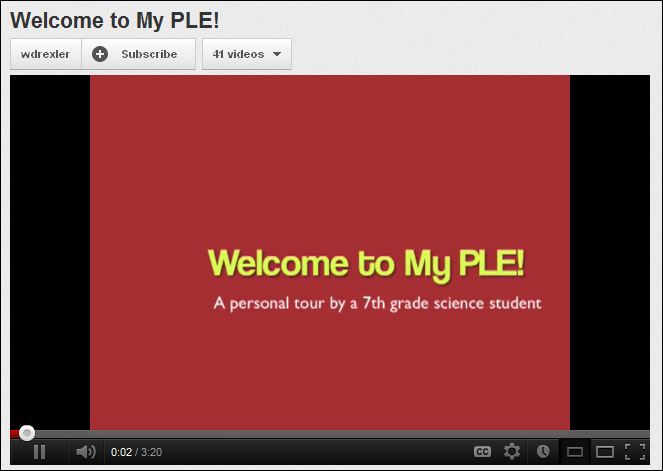
In the YouTube video, notice how a 7th-grade student created a personal learning environment in Symbaloo  http://youtu.be/YEls3tq5wIY

Welcome to my PLE

How do Students Organize the Personal Learning Environment?

Wouldn’t it be nice to just tell students how their personal learning environments (PLE) should be organized? Include elements A, B, and C, and you’re done! But that would not be very personal, would it? Personal learning environments are organized in a way that makes sense to the person doing the organizing.  Michelle Martin (2007), an adult blogger, organized hers according to the information she gathered, the information she processed, and the actions she takes based on her learning.  Two things are worth noting in her approach: 1. She changed the tools she used to organize her PLE after awhile, and 2. She included traditional paper-based text in her PLE.

The EdTechPost wiki includes many diagrams that illustrate how personal learning environments might be constructed. On the wiki, the diagrams are organized toward orientation: tools, use/action/ people, and hybrid/action/other.  Every personal learning environment is different because each reflects the way the person who created the environment perceives and organizes their learning and the worlds it represents.  Dionisio quickly realized that Symbaloo was a great tool, but he needed multiple entry points for his PLE representing the way he organized his own learning.  He created an About.me account to provide a more public access point for his music and interests in the Civil War.  The About.me page did include links to his Symbaloo and other pages, but some were password protected, and not all his school pages were linked to his About.me page.

What are the Elements of a Personal Learning Environment?
The Learning Technologies Centre at the University of Manitoba includes several elements of a personal learning environment. These include production tools, collaboration tools, aggregation tools, and so on (for the full list, click the link).  EDUCAUSE (2009) points out that a key attribute of the personal learning network is that it is learner centered.  Attwell (2006, pdf file) further explores the learner-centered feature of the personal learning environment. He suggests that they are characteristics of life-long learners and that they are informal in nature.  Another key element is the aspect of community (e.g., Grisham & Wolsey, 2006), the idea that much of our creative and intellectual work is part of a larger group, as well.

Why do Personal Learning Environments Matter?

A characteristic of humans is that they try to make sense of the contexts of their lives. The tools they use and the purposes they establish for learning may be the defining features of learning in the coming decades.  How will you encourage your students to create and maintain personal learning environments the promote mastery of appropriate standards and foster lifelong learning as well? Dionisio relied on his teacher to help him learn to organize and make sense of the many online tools he used. Like him, many K-12 students and adults create environments that serve their own purposes that include formal and informal contexts.

At the beginning of the post, we asked what a personal learning environment is.  Simply, it is the approach that users take to individual aggregate content, organize it, and lend context to it. Content may be created by the owner of the PLE or gathered from the Internet and other sources. PLEs are informal mashups, elements of which may be shared with others in the user’s network and learning communities. Finally, educators sometimes provide a basic framework or tool that students might use to start building their own PLEs.

More to Learn:

To continue your own exploration of personal learning environments, visit http://delicious.com/stacks/view/Qeck9Y  Also, read more about the related concepts of personal learning networks (which overlap with personal learning environments), social bookmarking, and content curation.

References

Attwell, G. (2006). Personal learning environments—The future of elearning? eLearning Papers. Retrieved from http://www.elearningeuropa.info/files/media/media11561.pdf

EDUCAUSE. (2009). Seven things you should know about personal learning environments. Retrieved from http://net.educause.edu/ir/library/pdf/ELI7049.pdf

Grisham, D. L. & Wolsey, T.D. (2006). Recentering the middle school classroom as a vibrant learning community: Students, literacy, and technology intersect. Journal of Adult and Adolescent Literacy, 49(8), 648-660. DOI: 10.1598/JAAL.49.8.2

Leu, D.J., Jr., Kinzer, C.K., Coiro, J., & Cammack, D.W. (2004). Toward a theory of new literacies emerging from the Internet and other information and communication technologies. In R.B. Ruddell, & N. Unrau (Eds.), Theoretical models and processes of reading (5th ed., pp. 1570-1613). Newark, DE: International Reading Association. Available: http://www.readingonline.org/newliteracies/lit_index.asp?HREF=leu/

Martin, M. (2007, April 11). My personal learning envirornment [blog post]. The bamboo project. Retrieved from http://michelemartin.typepad.com/thebambooprojectblog/2007/04/my_personal_lea.html