Teachers’ Perceptions of Feedback Efficacy

LiteracyBeat goes to Crete, Greece, June 25, 2024.

Linda, Dana, and Thomas present at the 23rd European Conference on Literacy, June 25, 2024.

Feedback on writing is often limited to rubrics even though more is possible. Feedback is one routine with potential to significantly improve student achievement. Nowhere, we argue, can feedback improve learning more than in writing instruction. Research we are conducting suggests that teachers perceive oral feedback to be particularly useful. Other research informs our work that suggests the teacher’s relationship with students may have an impact on the efficacy of feedback.

In general, teachers find useful feedback is easy to provide and believe their students review feedback they offer. Teachers seemed to prefer oral feedback, and nearly 60 percent of teachers believe their students use feedback to improve performance from one task to the next. However, teachers preferred simple (50.3% rank 1 or 2) and complex affirmations (67.75% rank 1 and 2) over other types of feedback.

During this session, we will examine what research suggests are effective practices in providing feedback to foster and to develop effective writing skills with a focus on oral feedback. We examine both tech and non-tech ways to provide feedback in terms of reinforcement (positive and negative) and signals to advance to the next level of proficiency, with the ultimate aim of accelerating learning.

We are grateful to Dr. Diane Lapp and the team at Health Sciences High and Middle College for their support during data collection. #Guilford Press
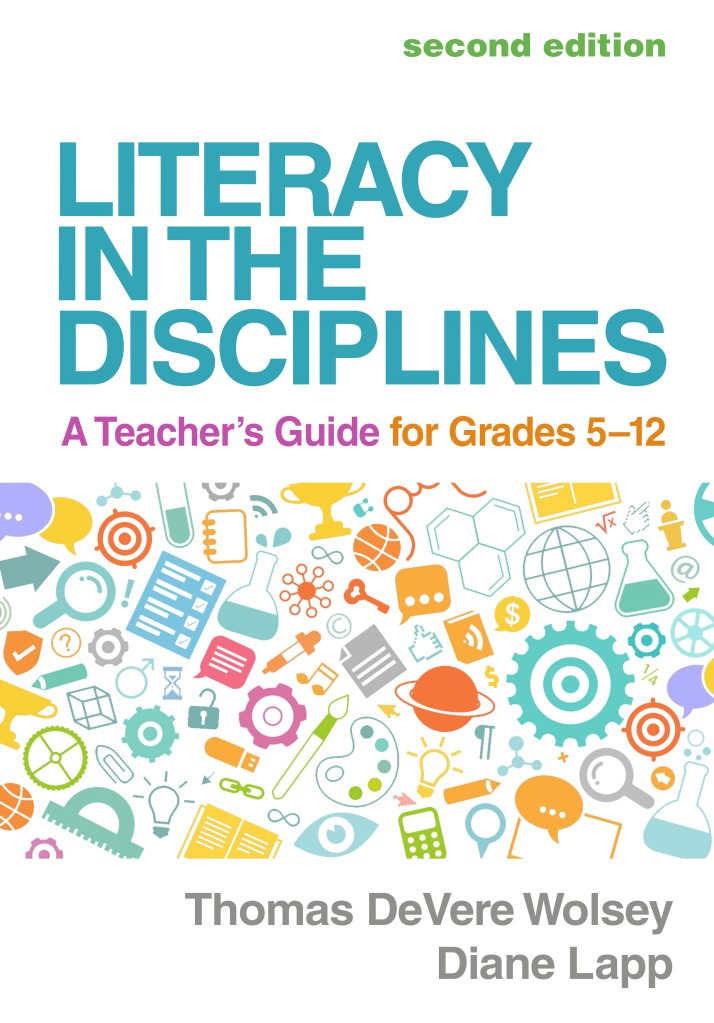
Also, watch for the 2nd edition of Literacy in the Disciplines with Dr. Wolsey and Dr. Lapp, new from Guilford Press. Preprint copies are available now for professors and professional development leaders (Contact Thomas for details and discount codes). The book is available August 12, 2024 for professional purposes and course adoption.

Do not forget to check out Assessment Literacy by Dr. Wolsey, Dr. Grisham, and Dr. Lenski.

Photos by Zoi Philippakos. Download presentation materials and book promotional materials at https://app.box.com/s/nm93q8joytgib322bq8gy5ee9853iter [Available until August 1, 2024).


An International Focus of the Language Arts and Literacy

by Thomas DeVere Wolsey

Our chapter in the Handbook of Research on Teaching the English Language Arts, 5th Ed. is chap ONE! Thanks to co-authors Ibrahim M. Karkouti, Pelusa Orellana, Cristina Alfaro, John Perry and editors Douglas Fisher and Diane Lapp.

https://www.taylorfrancis.com/chapters/edit/10.4324/9781003334392-2/international-focus-language-arts-literacy-thomas-devere-wolsey-pelusa-orellana-garcia-john-perry-ibrahim-karkouti-cristina-alfaro (Check it out!)

Abstract: This first chapter in the Handbook of Research on Teaching the English Language Arts, 5th Edition takes an international perspective on the teaching of English, as English has become the dominant language in the world. The chapter’s five authors, Wolsey, Orellana, Perry, Karkouti, and Alfaro, forecast trends and challenges in teaching English in their native countries of Egypt, Chile, the UK, the Middle East, and Mexico/United States respectively. Readers will discover that, in a transnational context, perspectives and challenges of teaching English are not all that different. The chapter begins with an explanation of the methodology used to select the topics in this chapter, as well as how the authors were chosen.

Teachers’ Perceptions of Feedback Efficacy

by Thomas DeVere Wolsey

Literacy Beat is in Kenya to talk about feedback with teachers, researchers, and policymakers in Nairobi.

City view of Nairobi

View the draft slide deck here:

Anti-rúbrica

By Thomas DeVere Wolsey

Ingredientes/Requeridos:

Ejemplos: Puntuación, Ortografía, párrafos (como superficial pero necesario)

Sugerencias y Desafíos ¿Cuáles son tus siguientes pasos?Criterios Estándares para este producto, tarea o desempeñoAvanzado ¿Cuál es la evidencia de que
este producto, tarea o desempeño ha excedido el estándar?
 Criterio #1: Descripción de dominio o competencia 
 Criterio #2: Descripción de dominio o competencia 
 Criterio #3: Descripción de dominio o competencia 
0 to 20 points21-22 points23 to 25 points

Learn more about anti-rubrics in Assessment Literacy (this is an affiliate link, but your price will not go up). | Obtenga más información sobre las anti-rúbricas en Assessment Literacy (este es un enlace de afiliado, pero su precio no aumentará).

Assessment Literacy Cover
Assessment Literacy: An Educator’s Guide to Understanding Assessment, K-12

@TDWolsey 2023 Permission is granted to duplicate for classroom use. | Se le permite duplicar esta anti-rúbrica para uso en el salón de clases.

Register Now for Beyond the App

by Thomas DeVere Wolsey & Nance Wilson

Registration for Beyond the App is open now!

Beyond the App is an interactive online conference for middle grades teachers, teacher educators, parents, and educational leaders. For just $10 you get to work with experts in the field to improve your online teaching of literacy.

You can read more about it in this press release: http://www2.cortland.edu/news/detail.dot?id=a01e318d-2666-4ecd-818c-3f7a144744dc

Visit our website and register (Your registration helps us fund the conference in the future): https://bit.ly/beyondtheapp

If you are registering from Africa, please send a note for special instructions to BeyondTheApp@Cortland.edu

In addition, participants can choose to donate to our EgyptReads! Initiative to put books in school libraries.

Some of our speakers:

Jack C Berckemeyer
Douglas Fisher and Nancy Frey
Maha Bali
Vicky Mac Arthur Cardullo
Zoi Philippakos
Troy Hicks
Emily Smothers Howell
Ian O’Byrne
Danny Brassell
Keisha Rembert
Jill Castek
Timothy Rasinski
Julie Coiro
Richard Beach
AND MORE!

Go Beyond the App

By Thomas DeVere Wolsey

Beyond the App Promo & Logo
Are you ready to go beyond the app?

Beyond the App invites teachers to interact with experts in online and traditional literacies. In contrast to many professional development activities, Beyond the App participants will co-construct approaches to teaching upper elementary and middle school students with colleagues around the globe.  The event is a joint project with the Literacy Department at the State University of New York at Cortland and Graduate School of Education at The American University in Cairo.

Participants will have the opportunity to choose strands or themes such as building fluency, motivation for learning online, assessment practices, and more. You are likely familiar with the Gradual Release of Responsibility Model represented by the phrases, “I [the teacher] do, We do, and You do.” Our focus is on the difficult challenge of providing appropriate literacy practices within the we do [it together] phase when teachers are working online, and students are learning. But, how do you do that when you are teaching online?

Join us to go Beyond the App.

Sign up for details via email on our LeadPages site.

Assessment Literacy: An Educator’s Guide to Understanding Assessment, K-12

By Thomas DeVere Wolsey & Dana L. Grisham with Susan Lenski

We are excited to announce that Assessment Literacy: An Educator’s Guide to Understanding Assessment, K-12 by Literacy Beat bloggers Thomas DeVere Wolsey and Dana L. Grisham with guest blogger Susan Lenski is now available.

Literacy Beat readers are invited to take 20% off the list price. Just point your browser to Guilford.com or use the promo code 2E on the Guilford website.

Assessment Literacy Cover

Assessment Literacy: An Educator’s Guide to Understanding Assessment, K-12

Overview:

This clear, no-nonsense book guides current and future teachers through the concepts, tools, methods, and goals of classroom literacy assessment. The expert authors examine the roles of formative, summative, and benchmark assessments; demystify state and national tests and standards; and show how assessment can seamlessly inform instruction. Strategies for evaluating, choosing, and interpreting assessments are discussed, as are ways to communicate data to parents and administrators. User-friendly resources include boxed vignettes from teachers and researchers, practical assessment tips (and traps to avoid), and 12 reproducible planning forms and handouts. Purchasers get access to a Web page where they can download and print the reproducible materials in a convenient 8½” x 11″ size.

Thanks to our reviewers: Missy Provost, Troy Hicks, Judith Dunkerly-Bean, Paula Dreyfuss, and Linda Smetana and to Diane Lapp, author of the foreword.

Exploring Digital Assessments: How Teachers Improve Learning Outcomes

By Thomas DeVere Wolsey

EduForum 2018 at The American University in Cairo, New Cairo, Egypt

November 3, 2018

Assessment is the fuel of learning. Confronted with mountains of data, teachers can feel overwhelmed.  Particularly frustrating, some assessments interrupt instruction and distract students. In this session, we explore how to make the climb over the data mountain manageable. We will investigate effective practices to align assessments and learning outcomes through technology-driven formative assessment. Embedding assessment directly into learning activities can help teachers adjust instruction and engage students with their learning at the same time.  Learn how to create electronic exit tickets. Make a game your students will enjoy while making real-time use of feedback based on their progress through the game environment. Assessment need not be a tedious chore. Put learning assessment in service of engaging learning environments.

As part of today’s presentation on digital tools for formative assessment, we used Survey Monkey to conduct a pre-assessment of what we know about assessments.

Formative Assessment

Next, we used Edmodo to create a short portfolio with images. Next, we explored project-based learning using an online portfolio at Dreamdo. Here is an example:  https://edu.dream.do/en/dreams/sciences/the-5th-grade-geology-unit

Games are great learning tools, but they can be very useful for assessment, as well. Three online games and assessment tools we tried out were OLogy, Sim Scientist, and Kahoot!

The power of the teacher’s human voice coupled with images of a student’s own work were the focus of our exploration of screencasting.  Cambridge English videos showed us how to use screencapture and a free screencapture program, Jing,  were demonstrated.

Online tools make generating rubrics a snap. Check these out:

*Teachnology offers rubrics at: http://www.teach-nology.com/web_tools/rubrics/ but you’ll need to register.
*Rubistar, a project of ALTEC, has a useful rubric generator available at: http://rubistar.4teachers.org/index.php
*Google add-in by dostuffgood.org Create and send customizable rubrics and scores to students by email for any assignment. https://chrome.google.com/webstore/detail/online-rubric/fiiglmgmcodoglllnbfebbhkfidikfbo?utm_source=permalink

Finally, we examined the role and possibilities of Big Data and educational assessment. Read more here and here.

800px-DARPA_Big_Data

Want to join our classroom? Navigate to classroom.google.com and enter the code in the image below. Some of the tasks have expired links, but you can see how the demonstration was set up.

Class Code

Learn more about EduForum 2018:

Link: http://eduforum-eg.com/index.php/sessions/exploring-assessments-how-teachers-improve-learning-outcomes/

Link: https://events.aucegypt.edu/?event=14151038

Meet the Influencer: Don Leu

Influencers Banner

Influencers

Don Leu is a colleague, mentor, and friend to the Literacy Beat bloggers, and he has consistently influenced our research since we met him. Don and the New Literacies Research Lab always have something innovative in the pipeline to lead our thinking. In this post, we are very pleased to introduce Don to you.  We asked Don to tell us about the ORCA project, Online Research and Comprehension Assessment. ORCA addresses the need for assessments and resources for online inquiry and research in our schools.  Read Don’s response to learn more about ORCAs and find the professional development resources that support it, all provided as a public service. 

Don Leu

Don Leu

What is Orca? 

Central to our students’ success in life will be the ability to conduct inquiry online in order to learn (Organisation for Economic Co-operation and Development [OECD], 2011; Rideout, Foehr, & Roberts, 2010) What does this process look like and how might we determine our students’ ability in this area so we can prepare appropriate instruction?  The ORCA Project (http://www.orca.uconn.edu) recently developed eight authentic assessments to measure online inquiry skills in science (human body systems).  The assessments are now freely available online.   A video describing these assessments is also available (see below).


The assessments appear in two formats: ORCA-Multiple Choice  (or ORCA-Closed) and ORCA-Simulation.  In each, students conduct online research about an important question in science and responses are largely auto-scored. Both formats have demonstrated acceptably high levels of reliability and validity, though the ORCA-Simulation has demonstrated a 10% higher level of reliability, compared to ORCA-Multiple Choice (See Leu, et al., 2014).

Our research with representative state samples of 1,300 students in Maine and Connecticut shows that, on average, 7th graders only perform successfully on about half of the skills required in online research, suggesting that they are not fully prepared in this area.  It also shows students are especially weak in critical evaluation skills and communication skills.  (See Leu, et al., 2015)

You are welcome to use these assessments for instruction, assessment, or professional development.  They may be accessed online without cost. A professional development module is also available.

ORCA

ORCA

References

Leu, D. J., Forzani, E., Rhoads, C., Maykel, C., Kennedy, C., & Timbrell, N. (2015).  The new literacies of online research and comprehension: Rethinking the reading achievement gap. Reading Research Quarterly, 50(1). 1-23. Newark, DE: International Literacy Association. doi: 10.1002/rrq.85. Available at: http://www.edweek.org/media/leu%20online%20reading%20study.pdf

Leu, D. J., Kulikowich, J., Sedransk, N., Coiro, J. Forzani, E., Maykel, C., Kennedy, C. (April 4, 2014). The ORCA Project: Designing Technology-based Assessments for Online Research, Comprehension, And Communication, American Educational Research Association. Philadelphia, PA.

Organisation for Economic Co-operation and Development [OECD.](2011). Students on line: reading and using digital information. Paris: OECD. Available at  http://dx.doi.org/10.1787/9789264112995-en

Meet Don:

Donald J. Leu is the John and Maria Neag Endowed Chair in Literacy and Technology at the University of Connecticut. He holds a joint appointment in Curriculum and Instruction and Educational Psychology in the Neag School of Education. A graduate of Michigan State, Harvard, and Berkeley, he is an international authority on literacy education, especially the new skills and strategies required to read, write, and learn with Internet technologies and the best instructional practices that prepare students for these new literacies. Don directs the New Literacies Research Lab in the Neag School of Education. He is a member of the Reading Hall of Fame, Past President of the Literacy Research Association, and a former member of the Board of Directors of the International Literacy Association.

Find Don at the University of Connecticut and the New Literacies Research Lab.

Student Oral Language Observation Matrix: Spreadsheet Style

By Thomas DeVere Wolsey

A time-tested standby to help teachers understand English learners’ oral language proficiency is the SOLOM or Student Oral Language Observation Matrix. The instrument is not a test, but it is an informative assessment that teachers use to inform instruction. There are many versions in html, Word, and PDF, but an interactive version in Excel (.xls) may prove useful.

SOLOM and Excel

SOLOM is in the public domain, so you may find some variations in the various published versions of the Matrix.   Teachers and teacher educators use the Matrix, developed by the San Jose (California) Bilingual Consortium, for a variety of purposes:

  • It fixes teachers’ attention on language-development goals;

  • It keeps them aware of how their students are progressing in relation to  those goals; and

  • It reminds them to set up oral-language-use situations that allow them to observe the student, as well as provide the students with language-development activities.

    Source: Center for Applied Linguistics

Download SOLOM (Excel)

Download SOLOM (Excel) here.

The Box.net file opens in preview mode; to download, find the upper right ↓ download arrow. Figure 1 shows where to locate the download icon.

SOLOM (Excel)

Figure 1: Download from Preview Mode – SOLOM Excel

What are the advantages of the Excel version of SOLOM?

  1. You can replicate this SOLOM digitally without killing any trees (no paper needed).
  2. You can add sheets for each student to keep all your results in one file.
    • Each sheet is accessed by the tabs at the bottom, left, of the spreadsheet. See figure 2. This template includes three sheets, but you can add more if you need them. Start here to learn how.

      Excel Tabs

      Figure 2: Excel Tabs

    • If you choose to do so, you can calculate results across sheets – a topic for a future post.
  3. The Excel spreadsheet does the calculations for you, an important feature if you have many students’ results to enter.

Want to review some common Excel terms? Navigate here. Maybe you want to dive into Excel vocabulary a bit more deeply? Point your browser here.

SOLOM Practice on YouTube

Several good YouTube videos allow you and your colleagues to practice using SOLOM. Try this one. This Playlist may also be useful.

Excel Geek?

If you happen to be an Excel geek, you can read this paragraph. Otherwise, just skip to the “Sources,” below. Excel is a powerful spreadsheet that harnesses the calculating abilities of the processor on your computer (or in the cloud). This version of SOLOM employs the COUNTA function to actually count the number of entries for each column, the SUM function to add up the column totals, and the VLOOKUP function to assign overall scores to a proficiency level. Shout out to gebobs for helping me find the function I should use instead of the one I was unsuccessfully trying to use!

SOLOM Sources

The best original source for SOLOM I can find is found at http://www.cal.org/ and opens as a PDF.

I adapted SOLOM for Excel from Arch Ford Educational Service Cooperative;  in Word format at SOLOM. (note: I removed the word “even” from cell B8).

Please share your variations and adaptations of SOLOM (Excel) in the comments section. What might you do to improve this tool? How have you used apps other than Excel to improve SOLOM or similar assessments